If you have ever eaten Korean food for the first time, you may have noticed something unusual.
There is rice.
There are chopsticks.
And yet many Koreans do not use chopsticks to eat their rice.
They use a spoon.
For many Western visitors, this may not seem strange at all. After all, spoons are common everywhere.
But if you compare Korea with nearby East Asian countries, it becomes surprisingly interesting.
In Japan, people usually lift the rice bowl and eat rice with chopsticks.
In China, it is also common to hold the bowl close and eat rice with chopsticks.
But in Korea?
The rice bowl usually stays on the table.
Then comes the spoon.
One scoop of rice.
One sip of soup.
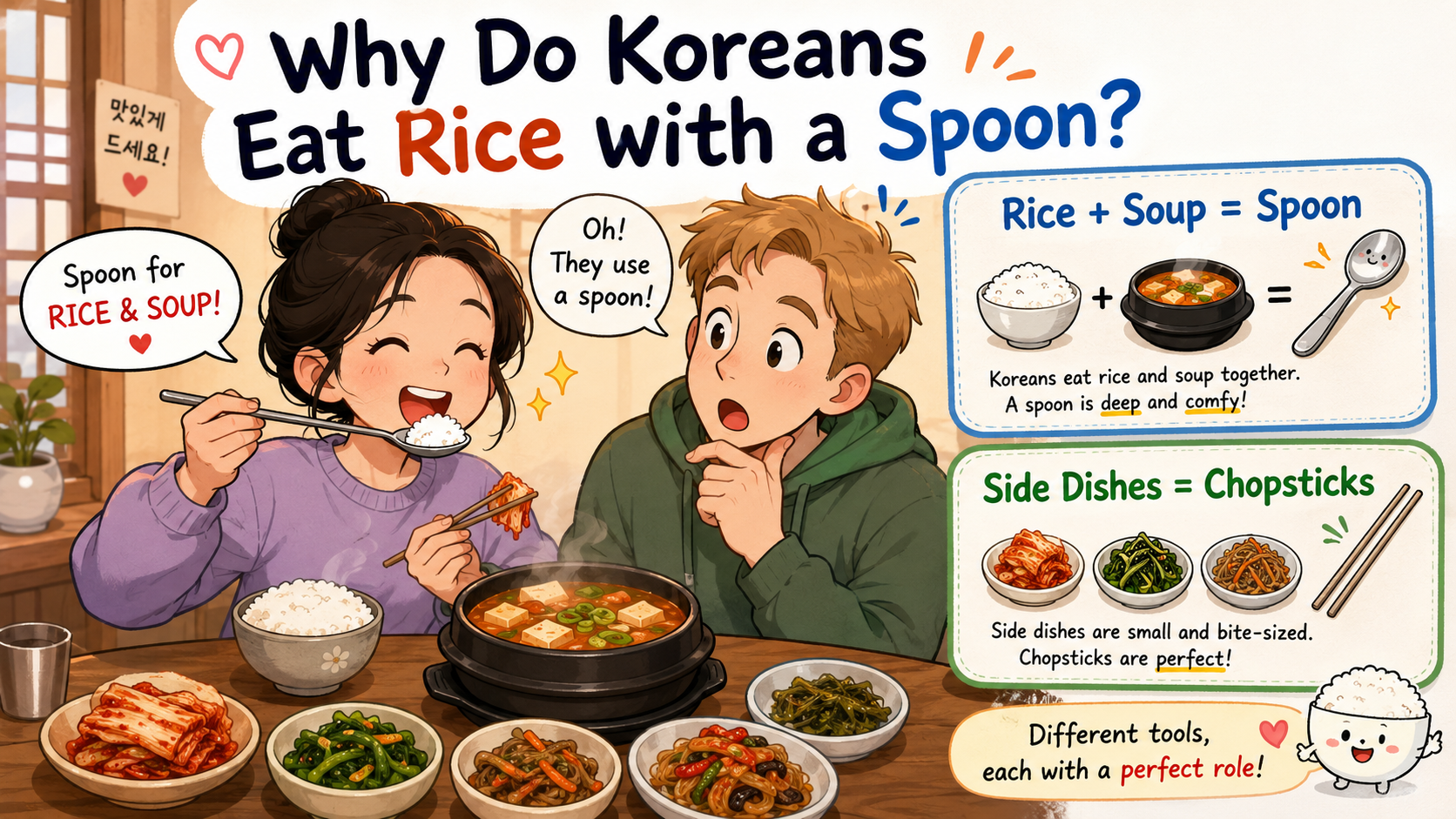
A piece of kimchi with chopsticks.
Rice again.
Soup again.
Kimchi again.
It is almost a rhythm.
So why did Koreans develop this particular way of eating?
The answer is not simply, “Because spoons are easier.”
The real story involves rice, soup, metal bowls, table manners, and hundreds of years of Korean food culture.
Rice Is Only Half the Story
To understand the Korean spoon, you first have to understand the Korean meal.
A traditional Korean meal is not just a bowl of rice surrounded by random side dishes.
It has a basic structure.
Rice is the foundation.
Soup or stew is usually placed next to it.
Then come several side dishes, called banchan.
These may include kimchi, seasoned vegetables, fish, meat, seaweed, pickles, or fermented foods.
So a typical Korean table might look like this:
Rice + soup + side dishes
This is important because Korean food is not built around rice alone.
Soup matters almost as much as rice.
Think about famous Korean dishes.
Miyeok-guk, seaweed soup.
Doenjang-guk, soybean paste soup.
Seolleongtang, ox bone soup.
Galbitang, beef short-rib soup.
Samgyetang, chicken and ginseng soup.
Then there are stews such as kimchi-jjigae, doenjang-jjigae, and sundubu-jjigae.
Try eating all of those with chopsticks.
Good luck.
You might catch a piece of tofu, but the broth will remain undefeated.
That is where the spoon becomes essential.
The Spoon and Chopsticks Have Different Jobs
Korean tableware works almost like a small team.
The spoon handles rice, soup, porridge, and stew.
The chopsticks handle side dishes.
Kimchi?
Chopsticks.
Spinach?
Chopsticks.
Grilled meat?
Chopsticks.
Rice?
Spoon.
Soup?
Definitely spoon.
In Korean, the spoon and chopsticks are often treated as a single set called sujeo.
The word combines the ideas of spoon and chopsticks.
This is already a clue.
In Korea, a meal is not designed around choosing either a spoon or chopsticks.
You need both.
They are partners.
You could almost imagine them arguing.
The spoon says:
“I take care of the rice and soup.”
The chopsticks reply:
“Fine. I’ll handle the kimchi.”
And somehow, this division of labor has worked for centuries.
Was It Always Like This?
It is easy to assume that China was always the “chopstick country” and Korea was always the
“spoon country.”
History is more complicated.
In ancient East Asia, both spoons and chopsticks were widely used.
Spoons were especially important when people ate grains, porridge, and soup.
Over time, food cultures changed differently in China, Korea, and Japan.
In parts of China, wheat-based foods such as noodles and dumplings became increasingly important.
Chopsticks were extremely practical for these foods.
In Korea, however, meals continued to emphasize rice together with soup and broth-based dishes.
That helped the spoon remain central to everyday eating.
So Koreans did not suddenly invent the idea of eating rice with a spoon.
Rather, Korea preserved and developed an older spoon-and-chopstick dining tradition in its own way.
Why Don’t Koreans Usually Lift the Rice Bowl?
Here is another cultural difference that many visitors notice.
Japanese diners often hold the rice bowl in one hand.
Chinese diners may do the same.
Koreans traditionally do not.
The rice bowl usually stays on the table.
The soup bowl stays there too.
The diner reaches down with a long-handled spoon.
Why?
One practical reason may be the kinds of bowls traditionally used in Korea.
Korean households historically used materials such as brass, bronze, and thick ceramic.
These bowls could be heavy.
They could also become quite hot.
Imagine holding a hot brass bowl full of steaming rice throughout an entire meal.
Your dinner might turn into an unexpected arm workout.
Leaving the bowl on the table and using a long spoon was far more convenient.
Over time, convenience became custom.
Custom became etiquette.
That is why lifting the rice bowl close to your mouth can still feel less traditionally Korean, especially during
a formal meal.
The interesting part is that the spoon and the bowl custom probably reinforced each other.
Because Koreans used spoons, they did not need to lift the bowl.
And because they did not lift the bowl, the spoon became even more useful.
Culture often develops exactly this way.
One habit supports another until nobody remembers which came first.
Why Are Korean Spoons So Long?
If you compare a Korean spoon with many Western or Japanese spoons, you may notice that the handle
is usually quite long.
That design fits Korean dining very well.
The food often remains on the table rather than being lifted close to the face.
Soups and stews are also served very hot.
A longer handle helps diners reach into bowls comfortably without bringing their hands too close to the heat.
It is especially useful for dishes served in deep bowls or stone pots.
The spoon is not just a random shape.
Its design reflects the way Koreans actually eat.
And Why Is Everything Metal?
Then we come to another surprise.
The spoon is metal.
The chopsticks are metal.
For many first-time visitors, Korean chopsticks are the real challenge.
Wooden chopsticks?
Easy enough.
Metal chopsticks?
Suddenly, picking up one slippery piece of japchae can feel like an Olympic event.
You grab it.
It escapes.
You try again.
It escapes again.
Meanwhile, the Korean person sitting beside you is casually picking up sesame seeds.
Koreans have used dining utensils made from many materials throughout history, including wood, bronze,
brass, silver, and later stainless steel.
Today, stainless steel spoon-and-chopstick sets are extremely common.
They are durable, reusable, easy to wash, and well suited to strongly seasoned Korean foods.
Think about kimchi.
Red pepper paste.
Soybean paste.
Garlic.
Sesame oil.
Fermented sauces.
Korean food can be colorful and powerful.
Metal utensils survive the experience beautifully.
What About the Famous “Silver Spoon Detects Poison” Story?
You may have heard a popular story that Korean royalty used silver spoons because silver could detect
poison.
It is a fascinating story.
And yes, silverware had symbolic and practical importance among elites.
But it would be too simple to say that Korea developed its entire metal utensil culture because kings were
worried about being poisoned.
Food traditions rarely come from one dramatic event.
They are usually created by many things working together:
available materials,
cooking methods,
tableware,
social customs,
hygiene,
durability,
and everyday convenience.
The poison story is memorable.
But the real history is much bigger.
Korea, Japan, and China: Same Rice, Different Rules
One of the most interesting things about East Asian dining is how three neighboring cultures can share
rice and chopsticks but still eat in very different ways.
Japan
Rice is commonly eaten with chopsticks.
The bowl is usually lifted by hand.
Because Japanese rice is sticky, it is easy to pick up in small bites.
China
Practices vary by region, but chopsticks are widely used for rice, noodles, vegetables, and meat.
Rice bowls may be lifted toward the mouth.
Korea
Rice usually stays in the bowl on the table.
The spoon is used for rice and soup.
Chopsticks are used for side dishes.
So the difference is not simply about the rice.
It is about the entire meal.
The tools match the food culture.
A Spoon Can Tell You a Lot About Korea
At first glance, a spoon looks like one of the most boring objects in the world.
But look closely, and it becomes a tiny cultural document.
It tells you that Koreans traditionally ate a lot of soup.
It tells you that rice bowls usually stayed on the table.
It tells you that meals were built around several foods eaten together rather than one main dish.
It even tells you something about family and social relationships.
In traditional Korean dining etiquette, younger people often waited for older family members to pick up their
spoon or chopsticks before beginning the meal.
Even today, many Koreans still instinctively wait for parents or grandparents to start eating first.
The spoon, then, is connected not only to food but also to respect.
Even the Korean Language Loves the Spoon
The spoon appears in Korean expressions too.
For example, the phrase hansotbap-eul meokda literally means “to eat rice from the same pot.”
It refers to people who live or work closely together, almost like family.
Another old-fashioned expression roughly translates as:
“He should at least be able to lift his own rice spoon.”
It means someone should be capable of supporting themselves.
In other words, the spoon became a symbol of livelihood.
To have a spoon was to have a place at the table.
And to have a place at the table was to belong to a household.
That gives an ordinary utensil a surprisingly emotional meaning.
K-Food Is Taking the Spoon Global
As Korean food becomes more popular around the world, people are not only discovering kimchi, bulgogi,
bibimbap, and Korean barbecue.
They are also discovering Korean eating habits.
And sometimes the food itself teaches the lesson.
Give someone a bowl of sundubu-jjigae and no spoon.
They will understand Korean spoon culture immediately.
Give them bibimbap and ask them to mix it with chopsticks.
They may eventually request international assistance.
The Korean spoon simply makes sense for Korean food.
That is why food culture travels together with eating tools.
K-food is not only about ingredients.
It is also about how those ingredients are eaten.
So, Why Do Koreans Eat Rice with a Spoon?
The simplest answer is this:
Because Korean meals developed around rice and soup together, while rice bowls traditionally
remained on the table.
The spoon became the most practical tool for both.
Chopsticks then took care of the side dishes.
Together, they formed the uniquely Korean sujeo culture.
So the next time you sit down at a Korean restaurant, look at the spoon beside your chopsticks.
It may look ordinary.
But it carries a long story.
A story of rice.
A story of soup.
A story of family meals.
And a story of how culture can survive in the smallest everyday habits.
Then take one spoonful of rice.
One spoonful of soup.
One piece of kimchi.
Congratulations.
You are eating in Korean rhythm.
'Korean Food and Daily Life' 카테고리의 다른 글
| Why Is Fried Chicken Paired with Beer in Korea? (0) | 2026.07.28 |
|---|---|
| Why Do Koreans Eat Special Food After Drinking? (0) | 2026.07.25 |
| Why Do Koreans Wrap Meat in Lettuce? (0) | 2026.07.23 |
| Why Do Koreans Grill Meat at the Table? (0) | 2026.07.23 |
| Why Do Koreans Eat Soup with Almost Every Meal? (0) | 2026.07.23 |


