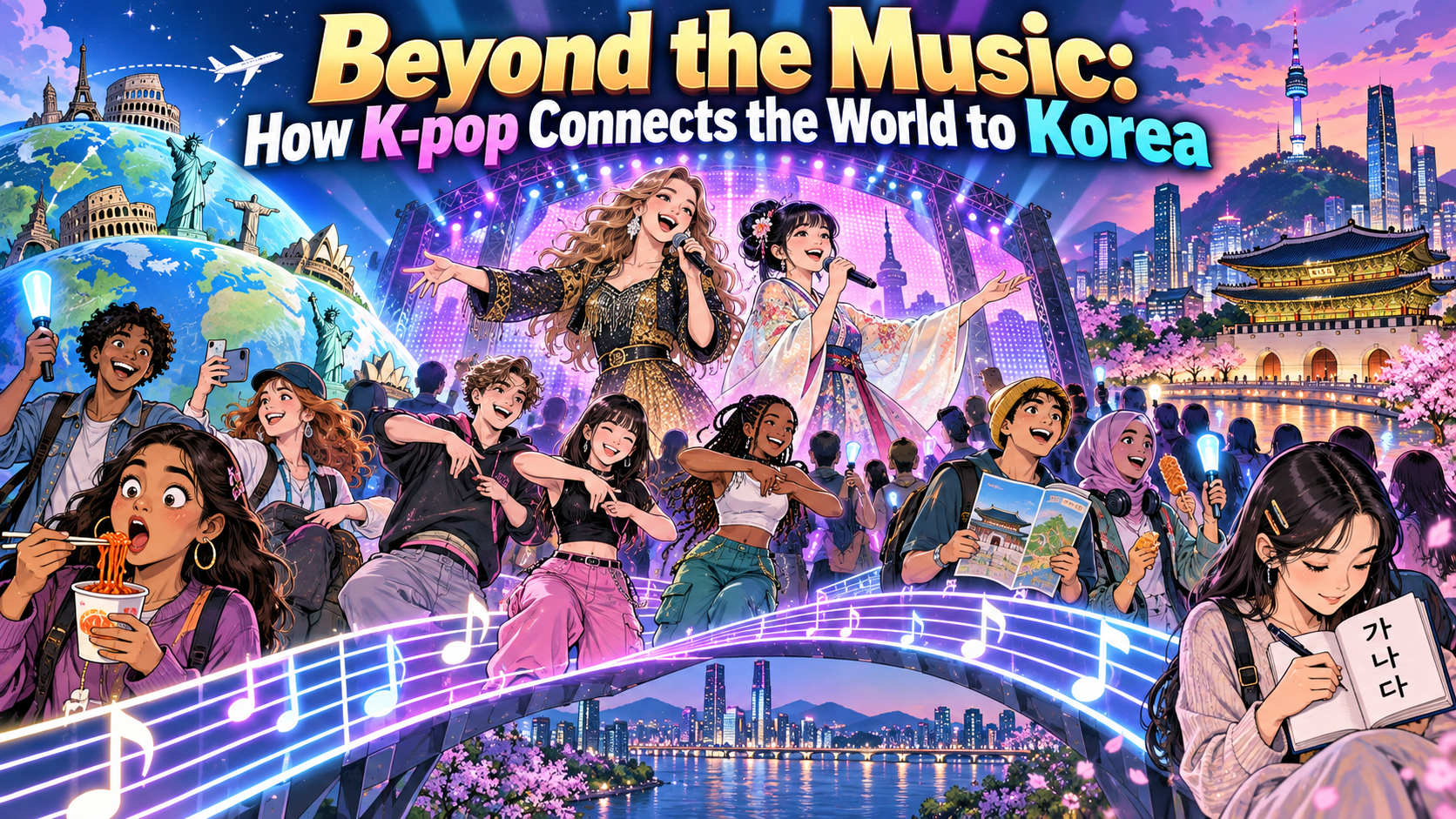
What does “I love K-pop” really mean? It may begin with one catchy song, but it rarely ends there.
A fan looks up the lyrics, learns the dance, watches variety shows, tries Korean food, and may even
study Hangul. Before long, a three-minute song has opened the door to an entire culture.
K-pop is a mixture of sound, choreography, fashion, storytelling, technology, language, and community.
Pressing play does not simply start a song. It connects the listener to a much larger world.
A performance for the ears and eyes
K-pop does not separate music from performance. A memorable chorus, synchronized dance, cinematic
video, stylish clothing, and each member’s personality work together. Even without understanding Korean,
a viewer can feel the emotion through movement, expressions, color, and rhythm.
A short signature dance also invites participation. Fans in Mexico, France, or Thailand copy it and upload
their own videos. Other people discover the song and join in. The audience no longer watches quietly;
it helps the performance travel.
Fans become part of the story
K-pop fandoms have names, colors, light sticks, chants, and online communities. Fans follow artists’ growth,
wait for comebacks, stream songs, translate interviews, and explain stories to newcomers.
Some groups also donate to charities, plant forests, or raise relief funds in an artist’s name.
The relationship can produce unhealthy competition over rankings, but it also creates cooperation.
A fan may become a translator, promoter, teacher, and organizer. K-pop spreads not only because companies
produce it well, but because millions of people voluntarily share and recreate it.
Music that teaches a language
A listener may begin with “saranghae” or “gwaenchana,” then learn Hangul to read lyrics and understand
livestreams. According to a Korea Foundation report, the number of Hallyu fans worldwide passed 200
million in 2023, and about 68 percent of the surveyed fan clubs centered on K-pop.
The report also noted a movement from consuming Korean content to learning Korean.
A textbook teaches grammar, but a favorite chorus supplies emotion and repetition. Words memorized for
an exam may disappear; words sung every day tend to remain. K-pop turns Korean from a distant code
into a living language.
From music to food, beauty, and travel
Fans taste tteokbokki seen in videos, copy an artist’s makeup, and visit filming locations.
A music video can become a small travel brochure, while a casual livestream can introduce Korean daily
life better than a formal lecture.
The 2025 Overseas Hallyu Survey found that K-pop was the image most often associated with Korea,
at 17.8 percent, holding first place for eight straight years from 2017. Korean food followed at 11.8 percent,
dramas at 8.7 percent, beauty at 6.4 percent, and films at 5.6 percent.
Among people who had experienced Korean cultural content, 70.3 percent viewed it favorably.
These areas travel together. Music creates curiosity, and curiosity moves toward food, television, fashion,
history, products, and tourism.
Foreign singers step through the door
American singer Maria Elizabeth Leise offers a fascinating example. She came to Korea through her interest
in K-pop but found her strongest voice in trot, an older Korean popular-music tradition.
On TV Chosun’s “Miss Trot 2,” her Korean pronunciation and emotional delivery attracted attention.
In 2021, she made her solo debut with “A Thousand Years of Love.” A young woman from Connecticut was
not merely copying Korean music; she was expressing its sorrow and excitement in her own voice.
Japanese singer Azuma Aki shows another side of the exchange. Performing from childhood, she brought
the emotional techniques of Japanese enka to Korean television. Her Korean rendition of the classic
“Tears of Mokpo” drew praise for its pronunciation and restrained vocal bends. On programs including
“Korea-Japan Top Ten Show,” she has crossed between Korean and Japanese songs, helping older music
meet younger audiences.
Maria and Azuma Aki are not typical idol K-pop singers. That distinction matters.
They show that the door opened by K-pop now leads to Korea’s wider popular-music world, including trot
and classic songs. Foreigners are no longer only listeners. Some have become performers who add new
voices and meanings.
A shared language between strangers
At a concert, people who cannot speak the same language can sing the same Korean chorus. Online,
one fan uploads a dance cover, another translates the lyrics, and someone else analyzes the video.
K-pop is not a finished product shipped in one direction.
It is continually rebuilt through global participation.
There are problems, including harsh trainee competition, appearance pressure, privacy violations, fan
conflicts, and commercialization. Loving K-pop responsibly also means caring about the health and rights
of the people behind the stage.
Still, its deepest power is clear. A song made in Seoul can make someone across the world ask,
“What is Korea really like?” That question may lead to language learning, food, travel, friendship, and
a better understanding of another culture. When curiosity grows into connection, K-pop becomes much
more than sound.
https://www.youtube.com/post/UgkxeaKHmB7ciEp92zuiVHz3hGOlgzeiRz_z
'Korean Culture Explained' 카테고리의 다른 글
| Why Are Dreams Considered Meaningful in Korea? (0) | 2026.09.01 |
|---|---|
| Why Do Koreans Consult Fortune-Tellers? (0) | 2026.08.19 |
| Why Do We Blow Out Birthday Candles on a Day That Celebrates Life? (0) | 2026.08.12 |
| Why Is Skincare So Popular in Korea? (0) | 2026.08.11 |
| Why Do Koreans Say “Our” Instead of “My”? (0) | 2026.08.09 |


