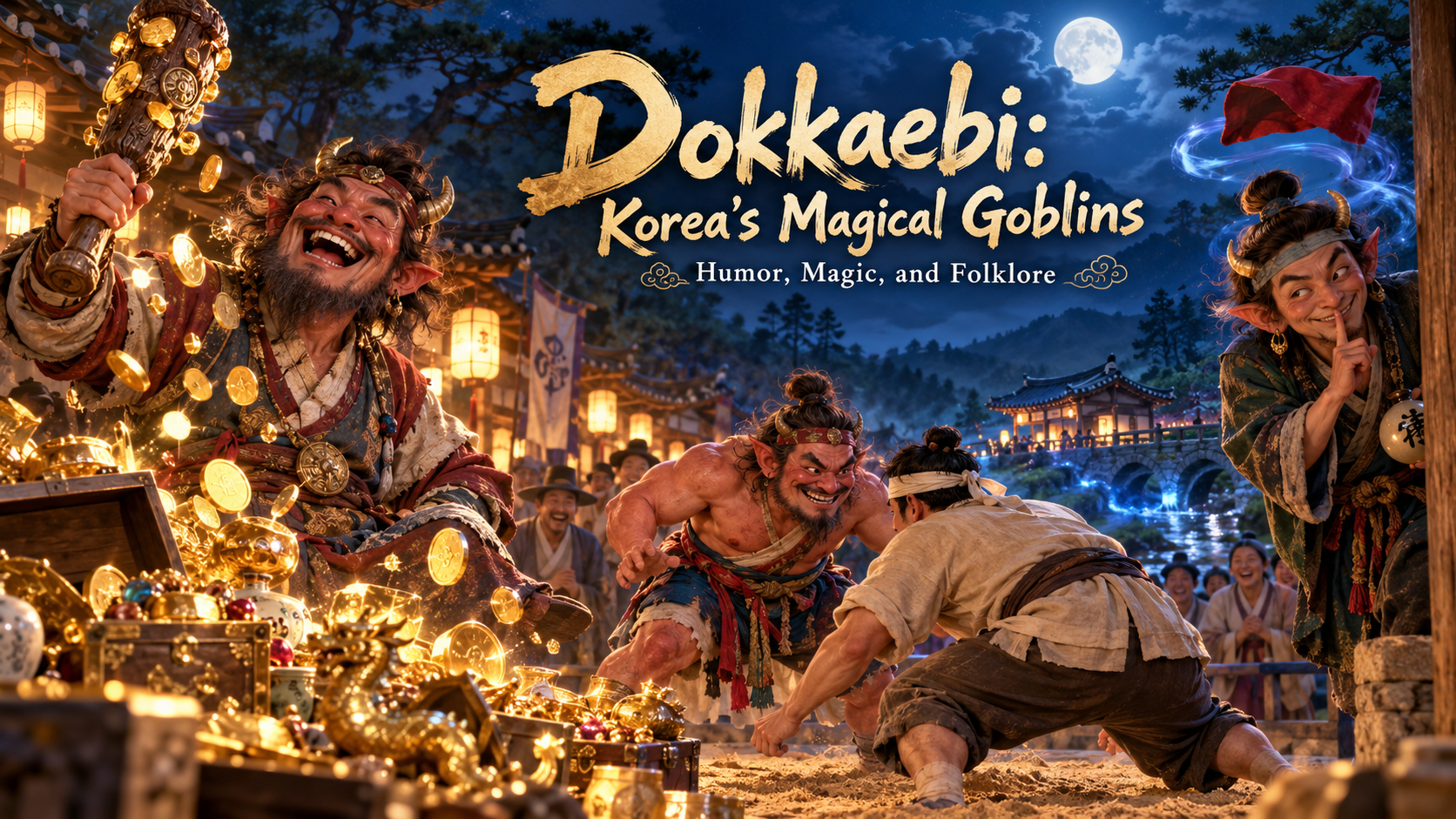
Magical clubs, invisible hats, midnight wrestling matches, and the strange creatures that reveal the Korean sense of humor
Imagine walking home on a dark mountain road in old Korea.
The moon is hiding behind the clouds. The trees are swaying in the wind.
Suddenly, a huge shadow appears in front of you.
"Hey, you! How about a wrestling match?"
You freeze.
Standing in your path is a strange creature with enormous strength and glowing eyes.
It's a dokkaebi — one of the most fascinating supernatural beings in Korean folklore.
You have no choice but to wrestle.
You struggle all night.
Finally, just before sunrise, you defeat the creature.
But when you look down at your defeated opponent, something unbelievable has happened.
The terrifying monster is gone.
In its place lies an old broom!
Welcome to the wonderful, strange, and sometimes hilarious world of Korean dokkaebi.
These creatures can make gold appear, become invisible, frighten travelers, and even help poor families
become wealthy.
But they can also be foolish, greedy, and surprisingly easy to trick.
What makes them so special?
And why have Koreans loved their stories for centuries?
Let's discover the history, mysteries, and humor behind one of Korea's most distinctive cultural traditions.
1. What Exactly Is a Dokkaebi?
The Korean word dokkaebi is often translated into English as "goblin."
But that translation doesn't tell the whole story.
A dokkaebi is not quite the same as a Western ghost, goblin, demon, or monster.
In Korean folklore, a ghost — called gwisin — is often connected to the spirit of a dead person.
A dokkaebi, however, does not necessarily come from a human soul.
In some stories, a dokkaebi develops from an old object.
Imagine a broom that has been used for many years.
Or a wooden tool forgotten in a shed.
Or a household object left untouched in an abandoned building.
What if, over time, a strange spiritual power entered that object?
What if it suddenly came alive?
That's one way traditional Korean imagination explains the appearance of dokkaebi.
Of course, not every legend gives the same explanation.
Different regions tell different stories about where dokkaebi come from.
But the idea that an ordinary object might become a supernatural creature is especially intriguing.
It suggests a world where the boundary between everyday life and magic is surprisingly thin.
The broom standing quietly in your kitchen might not be as ordinary as it seems!
2. Ancient Records: The Mysterious Story of Bihyeong
Dokkaebi-like supernatural beings appear in some of Korea's oldest surviving literary traditions.
One important source is the Samguk Yusa, or Memorabilia of the Three Kingdoms.
This collection of Korean historical traditions, legends, and religious stories was compiled by the Buddhist
monk Iryeon during the thirteenth century.
One famous story concerns a mysterious young man named Bihyeong.
According to the legend, Bihyeong was born through an extraordinary encounter involving the spirit of King
Jinji of Silla and a woman named Dohwa.
Bihyeong was no ordinary child.
At night, he secretly left the palace and gathered with supernatural spirits.
When King Jinpyeong learned about this, he decided to test Bihyeong's powers.
Could those spirits help construct a bridge?
Bihyeong gave the order.
And the supernatural beings built the bridge in just one night!
People later called it the Ghost Bridge.
The tale also describes another mysterious figure named Gildal, who was connected to Bihyeong and
eventually fled in the form of a fox.
These beings are described in the historical text as spirits rather than explicitly as the playful dokkaebi of
later folktales.
Scholars therefore debate how closely the story is connected to the origins of the modern dokkaebi tradition.
Nevertheless, it offers a fascinating glimpse into Korea's long history of stories about supernatural beings
interacting with humans.
3. The Old Korean Name: Dotgabi
Another important historical clue appears in a fifteenth-century Korean Buddhist text called Seokbo Sangjeol.
The text contains an old form of the word dokkaebi, written as dotgabi.
This tells us that the name and the idea behind it were already present in written Korean culture hundreds
of years ago.
Interestingly, dokkaebi were not always understood simply as evil monsters.
They could also be connected with human hopes for blessings, prosperity, and long life.
This is one of the most important things to understand about Korean folklore.
The supernatural world wasn't divided neatly into good creatures and bad creatures.
A mysterious being might bring danger one day and good fortune the next.
It depended on the story, the circumstances, and sometimes the behavior of the human characters.
4. The Magic Club That Could Make Gold
Perhaps the most famous magical object in Korean dokkaebi stories is the dokkaebi bangmangi.
Bangmangi means a club or wooden mallet.
But the dokkaebi's version is no ordinary tool.
It can magically produce treasures!
Imagine a poor woodcutter walking through a dark forest.
Suddenly, he hears voices.
"Gold, come out!"
BANG!
A dokkaebi strikes the ground with a magical club.
And gold appears.
"Silver, come out!"
BANG!
Silver appears too!
The woodcutter can hardly believe his eyes.
Through a fortunate turn of events, he manages to obtain the magical club.
Soon, his difficult life changes.
His family has enough food.
He can live comfortably.
But when a greedy person hears about his success, trouble begins.
The greedy man tries to copy the woodcutter.
Unfortunately, his selfishness brings punishment instead of treasure.
Different versions of this story have different characters and details, but the main message is clear.
Kindness and good fortune belong together, while excessive greed leads to disaster.
Why did Korean storytellers imagine such a magical club?
Perhaps because a simple wooden mallet was a familiar everyday object.
Ordinary people used wooden tools for farming, washing clothes, and preparing food.
By transforming a common tool into a source of unlimited wealth, storytellers created a wonderful fantasy.
For poor villagers struggling to survive, the idea of a magical club that could produce food or money must
have been irresistible.
5. The Old Man Who Lost His Lump
Another famous story associated with dokkaebi is Hokburi Yeonggam, often called The Old Man
with a Lump.
An elderly man has a large lump on his face.
One evening, he becomes lost in the mountains.
To make himself feel less afraid, he starts singing.
Suddenly, a group of dokkaebi appear.
They love his voice!
"Wonderful! What an amazing song!"
Then one curious dokkaebi asks:
"Where does that beautiful singing come from?"
The old man jokingly points to the lump on his face.
"Why, it comes from here!"
The dokkaebi become excited.
They decide to take the lump so they can have the wonderful singing for themselves.
To the old man's surprise, the lump disappears.
He goes home delighted.
But another greedy old man hears about his good fortune.
He tries to repeat the trick.
And instead of losing his own lump, he ends up with an extra one!
It's a wonderful comic ending.
However, there is an important historical complication.
The story became widely known in Korea through early twentieth-century school materials, including a
1915 reader published during Japanese colonial rule.
Because closely related Japanese stories exist and the earlier Korean documentary record is unclear,
scholars have questioned how confidently it can be classified as an originally Korean folktale.
It remains an important story in modern Korean children's culture, but its history should not be oversimplified.
6. The Invisible Hat: When Nobody Can See You
Now imagine another magical dokkaebi object.
A small traditional Korean cap known as a gamtu.
The dokkaebi's magical version can make its wearer invisible.
A poor man obtains one and immediately discovers its amazing power.
He puts it on.
Poof!
He disappears.
At first, he uses it to play jokes.
But soon he begins stealing food and valuable things.
After all, nobody can see him.
What could possibly go wrong?
One day, the hat is damaged.
A hole appears in the fabric.
The man repairs it with an ordinary piece of cloth.
Then he puts the hat on again.
He becomes invisible — except for the repaired patch!
Imagine watching a little piece of cloth floating through a crowded marketplace.
People begin to follow it.
The invisible thief tries to escape.
But the floating patch reveals exactly where he is.
And eventually, he is caught.
The ending is funny, but the question behind it is serious.
If nobody could see you, would you still choose to do the right thing?
The magical hat doesn't create greed.
It simply gives the man an opportunity to act without being seen.
What he chooses to do reveals his true character.
It's a surprisingly modern question for an old folktale.
7. Why Do Dokkaebi Love Wrestling?
Korean dokkaebi seem to have a particular fondness for wrestling.
In many stories, a traveler is walking home late at night when a strange giant blocks the path.
"Let's wrestle!"
The traveler is terrified.
But the dokkaebi refuses to let him pass.
So they begin wrestling.
The creature is incredibly strong.
It throws the man to the ground.
The man gets up.
They wrestle again.
And again.
Sometimes, the struggle continues until dawn.
Then, with a clever move, the human manages to overcome the supernatural opponent.
But when daylight comes, the giant is gone.
Only an old broom or wooden farming tool remains.
Why wrestling?
Traditional Korean wrestling, known as ssireum, was a popular form of entertainment and competition.
It required more than physical strength.
Balance, timing, and clever techniques were essential.
Dokkaebi wrestling tales transform that familiar sport into an extraordinary contest between humans and
supernatural beings.
The human may be weaker, but intelligence and determination can win.
It's a theme that appears again and again in Korean folk storytelling.
The powerful are not always wise.
And the weak are not always helpless.
8. Dokkaebi Fire: The Mysterious Lights of the Night
Imagine walking across a dark field and suddenly seeing a strange blue light.
It flickers.
It moves.
Then it vanishes.
A moment later, it appears somewhere else.
What would you think?
In traditional Korean villages, unusual nighttime lights were sometimes called dokkaebibul, or dokkaebi fire.
People told stories about strange lights moving across fields, mountains, rivers, and lonely roads.
Some believed the lights could lead travelers astray.
Others associated them with hidden treasures or mysterious spirits.
Such reports were part of a wider tradition of interpreting unusual nighttime experiences through folklore.
Modern explanations for similar sightings can include misidentified lights or natural phenomena.
But no single explanation should be assumed to account for every historical story.
The important point is how human imagination transformed mysterious experiences into memorable legends.
A tiny light in the darkness could become the beginning of a tale told for generations.
9. The Goblin Who Kept Repaying His Debt
Not every dokkaebi story is frightening.
Some are delightfully silly.
Consider the tale of a poor man who becomes wealthy because a dokkaebi keeps repaying a debt.
One day, a dokkaebi borrows money from a man.
Later, it returns to repay him.
"Here's the money I owe you."
"Thank you," says the man.
The next day, the dokkaebi returns.
"I've come to repay my debt!"
The man looks confused.
"But you already paid me yesterday!"
The dokkaebi scratches its head.
"Really? I don't remember that."
And it pays again.
Then it returns the following day.
And pays again!
Through the dokkaebi's strange forgetfulness, the poor man becomes rich.
The story reverses what we might expect.
A supernatural creature with extraordinary power is unable to remember something simple.
The ordinary human becomes the cleverer of the two.
Other regional stories tell of dokkaebi helping build structures or complete difficult work.
In a folktale collected in Sangju, North Gyeongsang Province, the famous historical general Gang Gam-chan
is linked with supernatural beings and a protective embankment.
Such stories show how dokkaebi could represent both mysterious danger and practical help.
10. Do All Dokkaebi Have Horns?
If you search for pictures of Korean dokkaebi today, you will probably see horned monsters holding spiked
clubs.
But were traditional Korean dokkaebi always imagined this way?
Not necessarily.
Historical descriptions and oral traditions vary considerably.
Some dokkaebi are enormous.
Others look almost human.
Some appear as small figures.
Others are associated with mysterious lights, shadows, or ordinary objects.
The familiar image of a horned monster also has a complicated history.
Korean visual culture developed through centuries of exchange with neighboring countries.
In modern times, Korean dokkaebi images and Japanese oni images have sometimes influenced one another, particularly in illustrations and popular entertainment.
But it would be misleading to say every Korean horned supernatural figure came directly from Japan.
Korea has its own long and varied traditions of spirit imagery.
The most accurate way to understand dokkaebi is not to search for one single "correct" face.
Instead, we should look at how these beings behave in stories.
Their personalities are often more important than their appearance.
11. Dokkaebi and the Hope for Prosperity
Dokkaebi also had a place in certain traditional folk beliefs.
In some communities, people connected them with wealth, abundance, and good fortune.
This makes sense when we remember how uncertain traditional life could be.
Farmers depended on weather and harvests.
Fishing communities depended on the sea.
A bad season could threaten an entire family's survival.
People naturally hoped for help from powers beyond their control.
In some local traditions, dokkaebi became associated with those hopes.
They could be approached or honored as supernatural beings capable of influencing prosperity.
This is very different from imagining dokkaebi as nothing more than frightening monsters.
They were part of a complicated relationship between people, nature, fear, and hope.
12. What Makes Korean Dokkaebi So Different?
The most charming thing about dokkaebi is their personality.
They're powerful, but they often make mistakes.
They're frightening, but they can be funny.
They may love drinking, dancing, wrestling, and playing tricks.
They sometimes help the poor.
They sometimes punish the greedy.
And sometimes, they are the ones who get fooled!
This makes them wonderfully human.
In many folktales, the audience laughs not because dokkaebi are harmless, but because such powerful
beings can behave so foolishly.
Imagine a creature that can produce unlimited gold but cannot figure out when someone is cheating it.
Or a giant who can lift enormous rocks but loses a wrestling match to an ordinary villager.
There's something deeply satisfying about these reversals.
They allow people without wealth or power to imagine defeating stronger opponents through intelligence
and courage.
That may be one reason dokkaebi stories became such an important form of popular entertainment.
13. From Ancient Folklore to Modern Korean Entertainment
Today, dokkaebi continue to appear in Korean popular culture.
You may encounter them in television dramas, fantasy novels, games, comics, festivals, and tourist
attractions.
Modern storytellers often give them entirely new personalities.
Some are romantic heroes.
Some are lonely immortals.
Some are powerful guardians.
Others remain mischievous troublemakers.
Their appearances have changed dramatically, but the central fascination remains.
Dokkaebi have supernatural abilities while experiencing recognizably human feelings.
They can be lonely.
They can be foolish.
They can become angry or jealous.
And sometimes, they simply want someone to play with.
This combination of magic and humanity makes them ideal characters for modern storytelling.
They can fit into comedy, horror, romance, adventure, or fantasy without losing their connection to
Korean tradition.
14. The Wisdom Hidden Inside Dokkaebi Stories
Every famous dokkaebi tale contains something worth thinking about.
The magical club asks what people would do if they suddenly became rich.
The invisible hat questions what happens to our morals when nobody is watching.
The wrestling stories celebrate cleverness over brute strength.
The strange nighttime lights reflect curiosity about the unknown.
The tales of helpful dokkaebi suggest that supernatural power can bring fortune as well as fear.
Together, these stories reveal a great deal about the people who told them.
They show the dreams of ordinary families struggling with poverty.
They reveal anxieties about greed and dishonesty.
They celebrate humor and quick thinking.
And they suggest that even the most powerful beings should never be taken too seriously.
Perhaps this is one of the distinctive pleasures of Korean folklore.
It can teach a moral lesson without becoming overly serious.
It can make us laugh while also encouraging us to think.
Final Reflection: The Goblin Who Looks a Little Like Us
The world has changed enormously since Korean villagers gathered to hear stories about dokkaebi.
Few people today expect to meet a supernatural wrestler on a dark mountain road.
And most of us know that a magical club won't suddenly produce gold.
Yet the questions inside these stories remain familiar.
Would wealth make us happier?
Would we remain honest if nobody could see us?
Can intelligence defeat strength?
Can we recognize kindness beneath an unusual appearance?
And how often do we allow greed to control our choices?
Korean dokkaebi are fascinating because they are not simply monsters from another world.
In many ways, they are exaggerated reflections of ourselves.
They are playful and selfish, generous and foolish, frightening and strangely lovable.
Perhaps that's why these mysterious creatures have survived in Korean storytelling for so long.
Not because people believe every magical adventure truly happened.
But because the stories reveal something timeless about human nature.
So the next time you hear someone mention a Korean dokkaebi, don't immediately imagine a terrible monster.
Imagine a strange creature laughing beneath a pine tree.
A magical club resting nearby.
A mysterious light flickering in the darkness.
And a booming voice calling out:
"Hey, traveler! How about a wrestling match?"
Just remember one thing.
If you win, don't be too surprised if your opponent turns out to be an old broom!
The real magic of Korean dokkaebi isn't only in their supernatural powers. It's in how much they reveal about the people who imagined them.
'Korean Folk Tales' 카테고리의 다른 글
| The Goblin Who Loved Rice Wine and the Tavern Keeper (0) | 2026.10.23 |
|---|---|
| The Serpent Bridegroom: A Mysterious Korean Love Story (0) | 2026.10.17 |

