A Korean Tale of Karma, Love, and Rebirth
If you visit Gyeongju, Korea’s ancient capital, two places will almost certainly appear on your itinerary:
Bulguksa Temple and Seokguram Grotto.
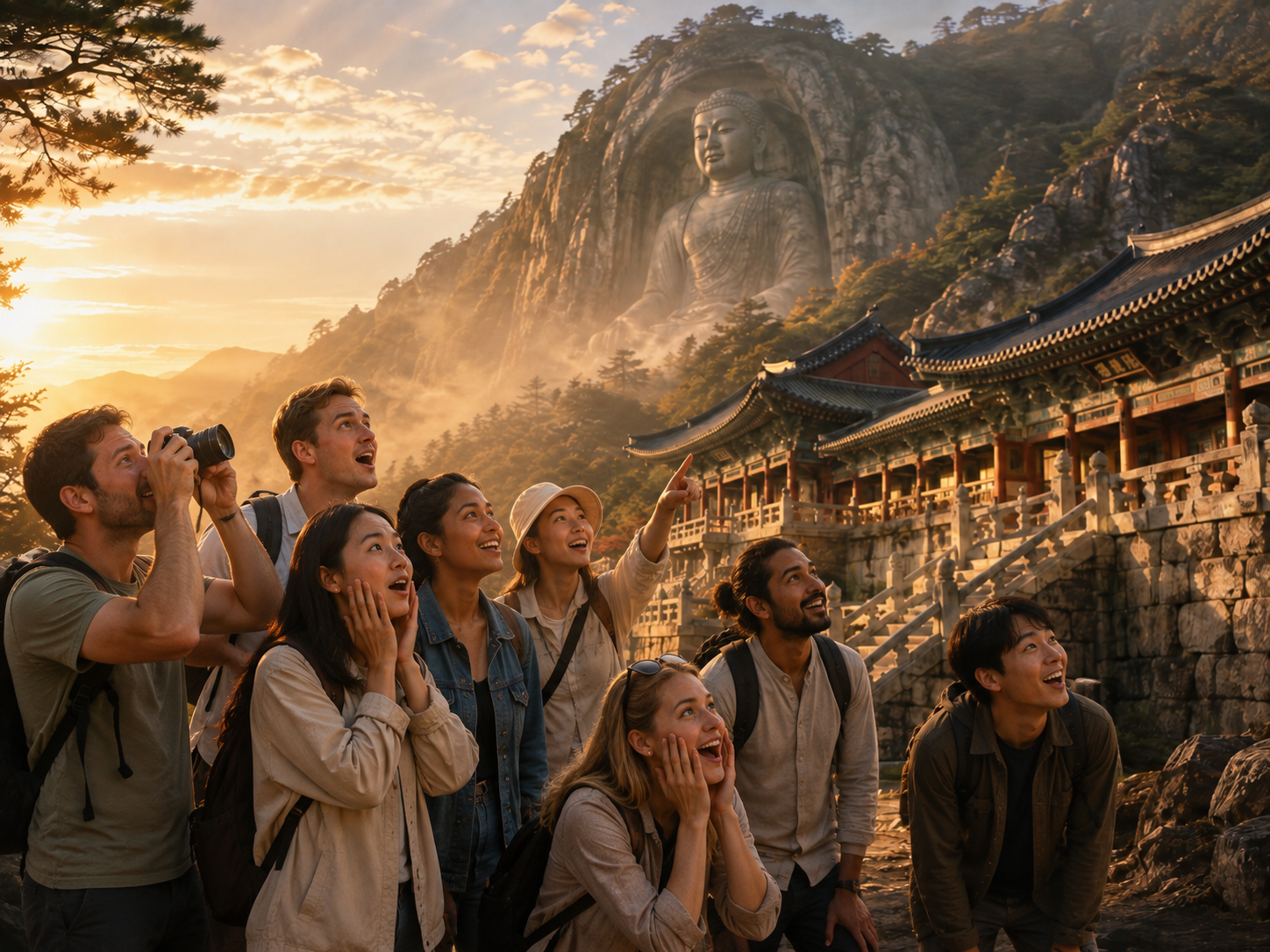
Bulguksa is famous for its elegant stone stairways, colorful wooden halls, and the beautiful Seokgatap
and Dabotap pagodas. Higher up on Mount Toham, Seokguram contains one of Korea’s most magnificent
Buddhist stone statues.
Today, both are treasured cultural landmarks.
But behind these masterpieces is a story that sounds almost like a movie.
It begins not with a king, a wealthy nobleman, or a famous architect.
It begins with a poor boy who owned almost nothing except a tiny field.
His name was Daeseong.
And according to one of Korea’s most famous historical collections, his small act of generosity eventually
became connected to two of the greatest Buddhist monuments in Korean history.
A Poor Boy and His Mother
The story appears in the Samguk Yusa, or Memorabilia of the Three Kingdoms, a famous collection of
Korean history, legends, Buddhist tales, and folklore compiled during the Goryeo period.
According to the story, a poor woman named Gyeongjo lived in a village called Moryang.
She had a son named Daeseong, meaning “Great Castle.”
The name sounded impressive, but his life was anything but grand.
Daeseong and his mother were extremely poor.
He worked for a wealthy family in order to survive, and after years of labor he was eventually given a small
piece of farmland.
To a rich man, it might have seemed insignificant.
To Daeseong and his mother, however, that field meant everything.
It provided the food that kept them alive.
In modern terms, it was almost their entire fortune.
Then one day, Daeseong heard something that changed his life.
“Give One, and Receive Ten Thousand Blessings”
A Buddhist monk came to the house of a wealthy man asking for donations for a temple.
The rich man donated fifty rolls of cloth.
The monk blessed him and said that because he had given generously, his good deed would bring him
great merit and blessings.
Daeseong happened to hear the monk’s words.
He began thinking.
“If giving creates merit, perhaps we are poor now because we failed to give in a previous life.
If I refuse to give anything in this life, won’t I remain poor in the next one as well?”
That evening, he returned home and told his mother something astonishing.
He wanted to donate their field to the temple.
His mother must have been shocked.
This was not simply an extra piece of property.
Without the field, they could lose their only source of food.
Giving away a small portion of great wealth is one thing.
Giving away almost everything you have is something completely different.
Yet according to the legend, Daeseong persuaded his mother.
They donated the field.
The poorest boy in the village had given away his greatest possession.
And then something terrible happened.
The Boy Suddenly Dies
Not long after making the donation, Daeseong died.
For his mother, the loss must have been unbearable.
She had already lived a difficult life, and now her only son was gone.
If this were an ordinary story, it might end as a tragedy.
But this is where the Buddhist legend becomes extraordinary.
Around the same time, something mysterious was said to have happened at the home of a powerful
aristocrat named Kim Munryang.
A voice was heard from the sky:
“The boy Daeseong of Moryang will now be born into this house.”
Soon afterward, Kim Munryang’s wife gave birth to a son.
The baby kept one hand tightly closed.
Seven days later, when the hand finally opened, the family supposedly discovered a golden object
bearing the characters:
大城 — Daeseong.
The child was therefore named Kim Daeseong.
The poor boy, the story tells us, had been reborn into a wealthy and influential family.
A Man with Two Sets of Parents
This is where the story becomes especially meaningful.
Kim Daeseong did not simply enjoy his new privileged life and forget everything that had come before.
According to the legend, he remembered the mother from his previous life and cared for her.
In other words, he now had two families.
There were the parents who gave birth to him in his present life.
And there was the mother who had raised him when he had been a poor boy in his previous life.
Later, when Kim Daeseong became a powerful official, he decided to repay both sets of parents in an
extraordinary way.
He began building two great Buddhist sanctuaries.
For his parents in his present life, he built Bulguksa Temple.
For his parents from his previous life, he built Seokbulsa, later known as Seokguram Grotto.
The Samguk Yusa even gives this story a title that can be understood as:
“Daeseong Shows Filial Devotion to His Parents of Two Lifetimes.”
For Koreans familiar with Buddhist ideas of rebirth and Confucian ideals of filial devotion, the story
combines two powerful traditions.
It is about karma.
But it is also about gratitude.
Bulguksa: A Buddhist Paradise on Earth
Bulguksa literally means something close to “Temple of the Buddha Land.”
The temple was designed to represent an ideal Buddhist world.
Visitors approach through beautiful stone stairways traditionally known as Cheongungyo and Baegungyo,
often translated as the Blue Cloud Bridge and White Cloud Bridge.
Inside stand two of Korea’s most famous pagodas.
Seokgatap is simple, balanced, and elegant.
Beside it, Dabotap is far more elaborate and decorative.
Together they have become symbols of classical Silla art.
Walking through Bulguksa today, it is easy to focus only on architecture.
But knowing the Daeseong legend changes the experience.
The temple becomes more than a beautiful historical site.
It becomes a gigantic expression of gratitude to one’s parents.
Seokguram: A Silent Buddha in the Mountain
Seokguram feels very different.
Instead of an open temple complex, it is a carefully constructed stone grotto located high on Mount Toham.
At its center sits a magnificent stone Buddha.
The figure is calm, balanced, and deeply peaceful.
For more than a thousand years, that Buddha has sat silently inside the mountain.
According to the legend, this sacred space was created in honor of Daeseong’s parents from his previous life.
That idea gives Seokguram an emotional depth that is easy to miss if you see it only as an ancient artwork.
Imagine a man standing on a mountain, remembering a poor mother from another lifetime.
Whether we believe literally in reincarnation or not, the message remains deeply human:
Do not forget those who loved and cared for you.
Did a Poor Boy Really Build These Temples?
Here, history and legend must be separated.
Kim Daeseong was a real historical figure and a high-ranking aristocrat of Unified Silla.
The large-scale construction connected with Bulguksa and Seokguram began around 751, during the reign
of King Gyeongdeok.
Kim Daeseong died before the projects were completed, and the work was later continued.
However, the story that he had previously been a poor boy who died and was reborn into an aristocratic
family belongs to the Buddhist legendary tradition recorded in the Samguk Yusa.
So did the reincarnation really happen?
History cannot prove it.
But perhaps that is not the most important question.
Legends often survive not because every detail can be verified, but because they express values that people
want to remember.
And this story carries several powerful ideas.
Good deeds are never meaningless.
Gratitude should not be forgotten.
Wealth is less important than how we use it.
And even a small act of generosity may create consequences far beyond what we can imagine.
From a Tiny Field to a World Heritage Site
Kim Daeseong did not live to see the final completion of the monuments associated with his name.
Yet Bulguksa and Seokguram endured.
In 1995, the two sites were jointly inscribed on the UNESCO World Heritage List.
Millions of people have since visited them.
Kings disappeared.
Dynasties rose and fell.
Wars passed through Korea.
Generations came and went.
Yet the stone pagodas of Bulguksa still stand, and the Buddha of Seokguram still sits quietly inside
Mount Toham.
That is what makes the story so remarkable.
It begins with almost nothing.
A poor boy.
A struggling mother.
A tiny field.
And one decision to give.
Yet more than a thousand years later, people are still telling his story.
What Is the Real Miracle?
So what is the true miracle of Kim Daeseong?
Was it that a poor boy was reborn into a wealthy family?
Was it that one man helped create two masterpieces?
Or was it that his story survived for more than a thousand years?
Perhaps the greatest miracle is much simpler.
A small act of generosity became a story about compassion.
A son’s gratitude became a story about filial love.
And two ancient Buddhist monuments became symbols that still speak to people today.
When you visit Bulguksa or Seokguram, you may see magnificent architecture, Buddhist art, and the
achievements of ancient Silla.
But behind the stone and wood, imagine one more thing.
Imagine a poor boy standing beside a tiny field, deciding to give away almost everything he had.
He could never have known what his story would become.
And perhaps that is why the legend remains so beautiful.
Sometimes the greatest legacy begins not with what we possess, but with what we are willing to give.


