There are moments in life when courage is not enough.
You can run, think, struggle, and search for a way out—but sometimes there is simply nowhere left to go.
Imagine this.
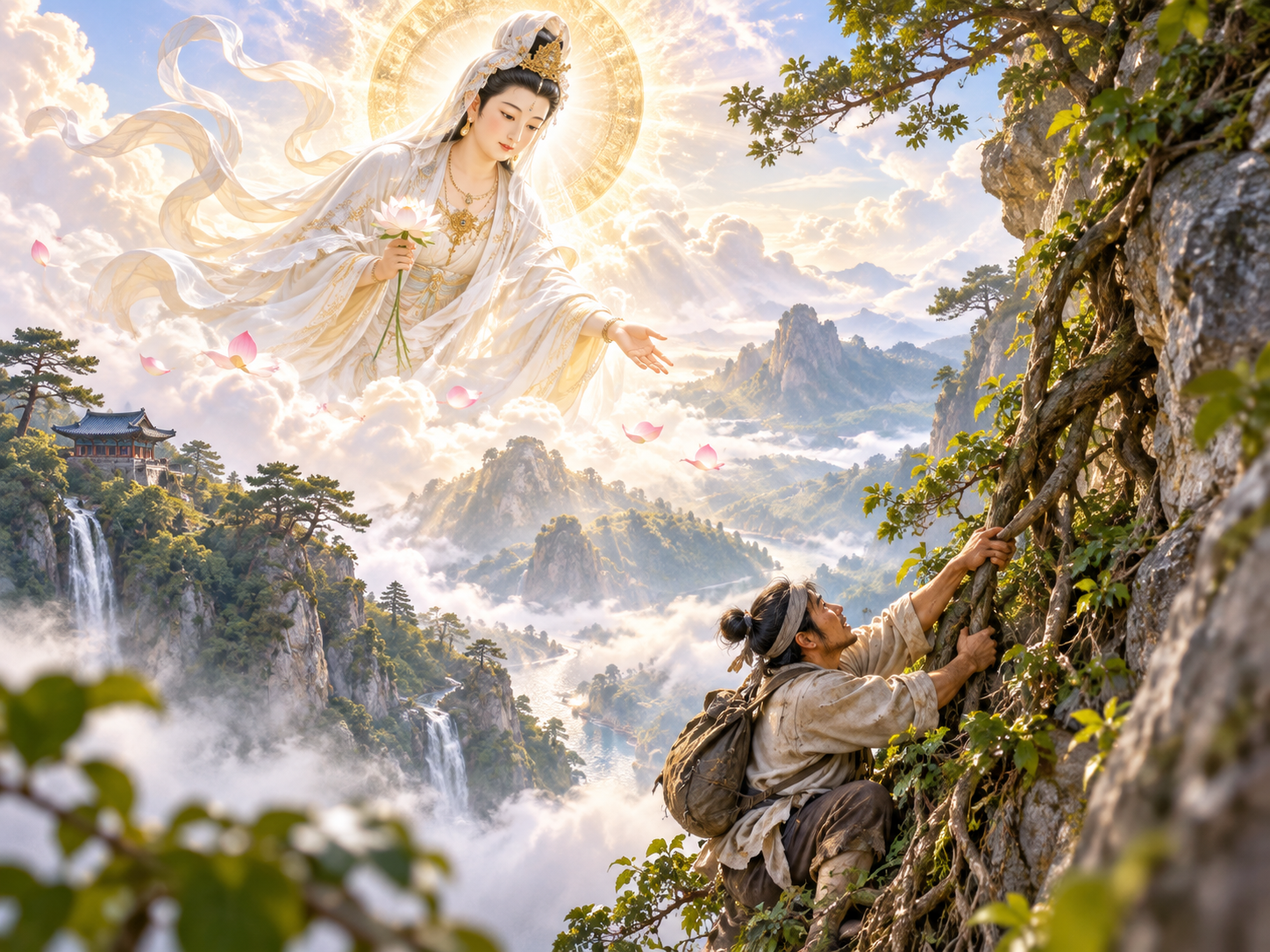
A man is trapped at the edge of a sheer mountain cliff. Behind him, armed bandits are closing in.
In front of him, there is nothing but empty air and a deadly drop.
No road.
No rescue.
No time.
And in that terrifying moment, he does the only thing he can still do.
He cries out:
“Gwanseum Bosal!”
What happens next became one of those Buddhist stories that people remember not because it is spectacular,
but because it speaks to something deeply human:
What do we hold on to when everything seems lost?
A Traveler in the Mountains
Long ago, there lived a man who had deep faith in Gwanseum Bosal, the Bodhisattva of Compassion.
In Korean Buddhism, Gwanseum Bosal is one of the most beloved bodhisattvas.
The name comes from the idea of “hearing the cries of the world.”
Not just ordinary sounds.
The cries of fear.
The cries of grief.
The cries of people who have no one else to call.
The man in our story often repeated:
“Namu Gwanseum Bosal.”
It was not a complicated prayer.
It was simply a way of turning his heart toward compassion whenever he was afraid or troubled.
One day, he had to cross a remote mountain region.
There were no paved roads, no emergency phones, no GPS, and certainly no rescue helicopter waiting nearby.
The path was narrow.
The forest was deep.
And danger was very real.
As he walked, he began to hear footsteps behind him.
At first, he ignored them.
Then came rough voices.
He looked back.
Bandits.
And they were coming straight toward him.
The Chase Begins
The traveler ran.
Branches struck his face.
Thorns tore at his clothes.
Loose stones rolled under his feet.
Behind him, the voices grew louder.
“Stop!”
But of course he did not stop.
He ran harder.
His lungs burned.
His legs shook.
Still, he kept going.
Then suddenly, the trees disappeared.
The path ended.
And there it was.
A cliff.
A huge, terrifying drop into a valley far below.
The man froze.
He looked behind him.
The bandits were getting closer.
He looked forward.
Nothing.
He had reached the end of the road.
Literally.
“I’m Going to Die”
For a few seconds, he had no plan.
No clever strategy.
No secret escape route.
Just fear.
Anyone who has ever faced a truly desperate moment can understand that feeling.
Sometimes life also gives us “cliffs.”
Not always made of stone.
A diagnosis.
A financial crisis.
The loss of someone we love.
A broken relationship.
A problem that seems impossible to solve.
For the traveler, the cliff was real.
And he believed his life was over.
Then, in that instant, one name rose from his memory.
The name he had repeated for years.
The name connected in his heart with mercy.
He closed his eyes.
And cried out:
“GWANSEUM BOSAL!”
The Fall
As the bandits approached, the man stepped backward.
His foot slipped.
For one terrible moment, there was nothing beneath him.
He fell.
Wind rushed past his face.
The cliff seemed endless.
And again he shouted:
“Gwanseum Bosal!”
Then—
everything stopped.
The man opened his eyes.
He was not at the bottom of the valley.
He was hanging from branches and thick vines growing out of the cliffside.
Somehow, they had caught him.
He checked his arms.
His legs.
He was injured, but alive.
Above him, the bandits looked down.
Perhaps they assumed no one could survive such a fall.
Soon, they disappeared.
The traveler waited.
Then slowly, carefully, painfully, he climbed down to safety.
He had survived.
Was It a Miracle?
That is the question modern readers may immediately ask.
Was it truly a miracle?
Was it simply luck?
Were the branches there by chance?
A Buddhist story does not always demand a scientific answer.
Its deeper question is different.
What did the man experience at that moment?
To him, the branch was not merely a branch.
The vine was not merely a vine.
They became the hands that kept him alive.
That is why stories like this have survived for centuries.
They express the Buddhist idea that compassion does not always arrive in a dramatic supernatural form.
Sometimes it appears as something ordinary.
A branch.
A stranger.
A phone call.
A doctor.
A friend.
A delay that prevents an accident.
A sentence that stops someone from giving up.
Who Is Gwanseum Bosal?
For readers unfamiliar with Buddhism, Gwanseum Bosal is the Korean name for Avalokiteshvara, the Bod-
hisattva of Compassion.
In China, the figure is widely known as Guanyin.
In Japan, as Kannon.
In Korea, as Gwanseum Bosal.
Across East Asia, countless people have prayed to this bodhisattva in times of danger, illness, grief,
childbirth, separation, and fear.
The symbolism is powerful.
Gwanseum Bosal is not imagined as a distant being who ignores human pain.
Instead, the bodhisattva is believed to hear suffering and respond to it.
That is why one of the most famous sections of the Lotus Sutra, the Universal Gate Chapter, describes
people calling upon Avalokiteshvara in moments of danger.
Fire.
Flood.
Weapons.
Robbers.
Disaster.
Fear.
Again and again, the message is the same:
Do not lose the heart that calls for compassion.
“Namu Gwanseum Bosal” — What Does It Mean?
The phrase may sound mysterious to foreigners, but the meaning is quite simple.
Namu means something like:
“I take refuge in.”
“I entrust myself to.”
“I turn toward.”
So:
“Namu Gwanseum Bosal”
can be understood as:
“I take refuge in the Bodhisattva of Compassion.”
It is not about saying magic words perfectly.
It is about the state of mind behind them.
Trust.
Surrender.
Hope.
And the refusal to let fear completely destroy the heart.
Why This Story Still Matters
Most of us will probably never be chased by bandits to the edge of a mountain cliff.
But emotionally?
Many of us know exactly what that cliff feels like.
There are moments when we think:
“There is no way out.”
“I cannot handle this.”
“Everything is finished.”
And that is where this old Buddhist story becomes surprisingly modern.
It tells us:
The end you see may not actually be the end.
There may be a branch below you that you cannot yet see.
There may be help already on its way.
There may be strength inside you that appears only when you think you have none left.
The man did not know the branches were there.
He simply called out.
Then he fell.
And only afterward did he discover what was holding him.
That may be the most beautiful part of the story.
Compassion Is Not Always Dramatic
People often expect miracles to be spectacular.
A flash of light.
A divine voice.
A supernatural rescue.
But Buddhist compassion is often described in quieter ways.
A teacher appears when you need guidance.
A friend calls at the right time.
A doctor notices something early.
A stranger offers unexpected kindness.
You miss a train—and later discover that the delay changed everything.
We usually call these things coincidence.
Buddhist tradition sometimes invites us to look at them differently.
Not necessarily as proof of supernatural intervention, but as reminders that life is supported by countless
conditions, relationships, and acts of compassion.
Some we notice.
Many we never do.
The Branch Below the Cliff
This is why the image of the branch is so powerful.
When the traveler stood at the top of the cliff, he could not see it.
He saw only death.
But below him was something capable of holding him.
Life can be like that.
We judge the future using only what we can see from where we are standing now.
And sometimes that view is painfully limited.
The Buddhist message is not:
“Nothing bad will ever happen.”
It is much deeper.
It says:
Even in suffering, do not completely abandon hope.
Even at the edge of the cliff, compassion may still be present.
Even when you cannot see the next step, something may still be supporting you.
A Story About More Than Survival
Perhaps the traveler’s greatest miracle was not simply that he lived.
Perhaps the true miracle came afterward.
A person who has once been saved often sees the world differently.
A meal feels more precious.
A sunrise feels brighter.
A loved one’s voice sounds different.
And sometimes, a person who has received compassion becomes more willing to give compassion.
That is one of the central ideas of Buddhism.
Compassion should not stop with us.
If someone once became the branch that saved us, then one day we should become the branch for someone
else.
A kind word.
A helping hand.
A patient ear.
A little courage offered to someone standing at their own invisible cliff.
Final Thought
The traveler believed there was nothing below him.
But there was.
A branch.
A vine.
A chance to live.
That is why this ancient Buddhist story continues to move people.
It reminds us that when life seems completely closed, we may still be held by something we cannot yet see.
So if you ever find yourself standing at your own “cliff,” perhaps remember this old story.
And remember the traveler’s cry:
“Namu Gwanseum Bosal.”
Not as a guarantee that every problem will disappear.
But as a reminder:
Do not surrender your heart to despair.
Because sometimes, just beneath the place where you think everything ends,
a branch is already waiting.
https://www.instagram.com/oldsword0912/reel/Dc46R66qvFs/
'Korean Buddhism and Spirituality' 카테고리의 다른 글
| The One Lamp That Would Not Go Out: The Buddhist Story of the Poor Woman’s Lamp (1) | 2026.09.06 |
|---|---|
| The Otter That Changed a Man’s Life: The Buddhist Legend of Monk Hyetong (0) | 2026.09.06 |
| The Poor Boy Who Built Bulguksa and Seokguram (0) | 2026.09.03 |
| The Dream of Josin: He Lived a Lifetime in a Single Night (0) | 2026.08.27 |
| Was the Blue Bird Really an Incarnation of Avalokitesvara? (0) | 2026.08.26 |


