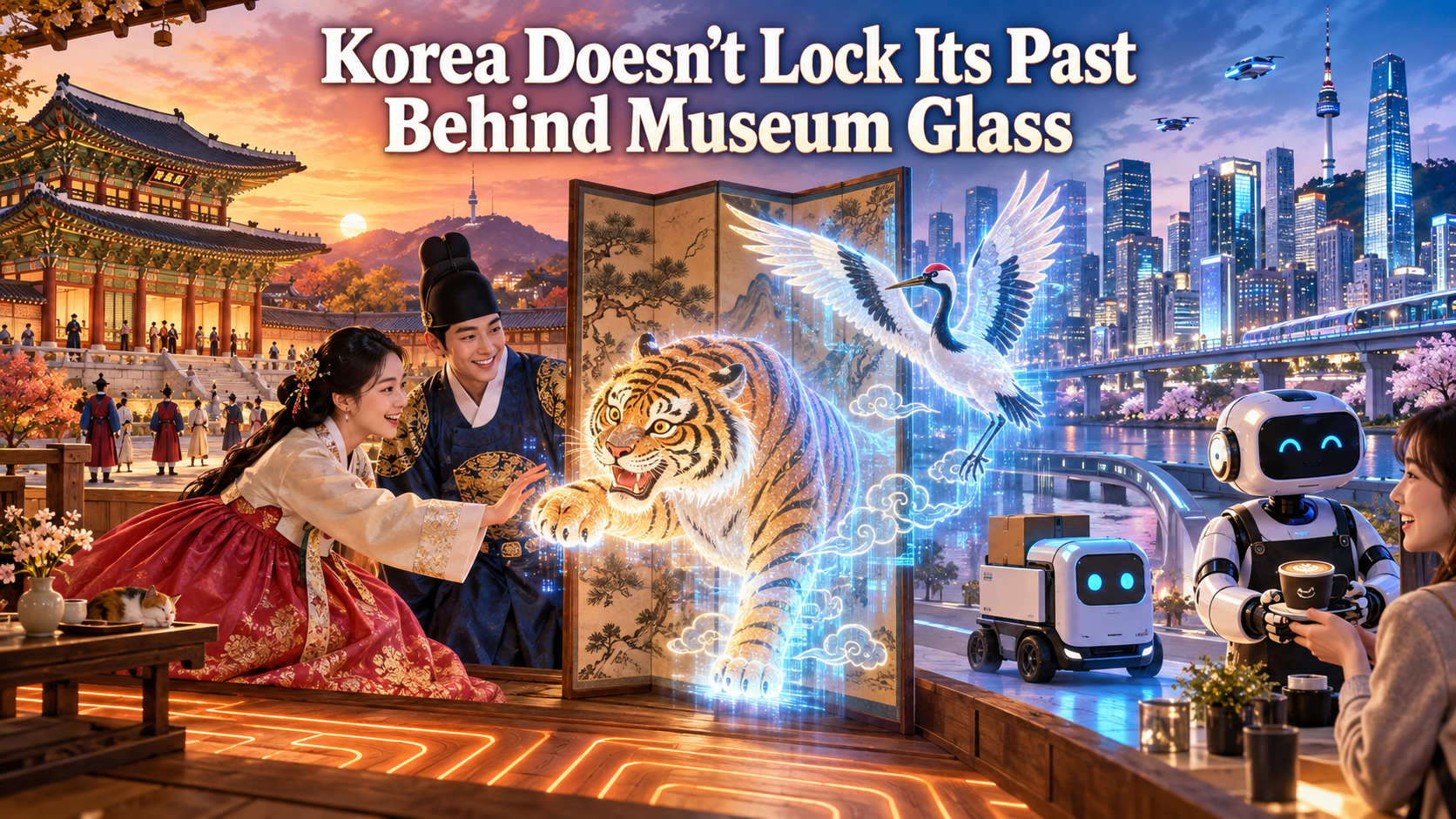
How Ancient Traditions Find New Life Through Modern Technology
A first-time visitor to Seoul may feel that several centuries have been mixed together.
In the morning, you wear a hanbok at Gyeongbokgung Palace. At lunch, you order from a touchscreen kiosk.
Later, you leave an old alley and find a robot making coffee. At night, traditional tigers race across a giant
screen on a glass skyscraper.
Tiled roofs share the skyline with apartment towers, while temple bells and phone alerts sound on the same
street. The past and future meet, borrow from each other, and occasionally take selfies together.
Tradition is still a daily habit
During Seollal, families compete online for train tickets, then bow to their elders and eat tteokguk.
A digital journey ends with an old family ritual. The tools change while the meaning continues.
Ondol gets a smart control panel
Enter a Korean home in winter and the floor may be wonderfully warm.
This is the modern descendant of ondol, Korea’s traditional floor heating.
In the past, heat from a fire moved through channels beneath a stone floor. Today, hot water runs through
pipes under apartment floors, and residents adjust the temperature by phone.
The house looks futuristic, but the central idea is ancient: warm the surface touching the body, not only the air. Technology did not replace ondol. It simply gave ondol an app.
Wi-Fi under a hanok roof
A hanok, or traditional Korean house, was designed around natural materials, wind, sunlight, and the seasons.
Its courtyard and deep eaves helped it breathe in summer.
Modern hanok guesthouses may include air-conditioning, Wi-Fi, digital locks, bathrooms, and beds.
The Korea Tourism Organization introduces both preserved houses and modern reinterpretations with
convenient facilities.
The trick is to add comfort without removing the building’s soul. A visitor may unlock the door by phone, then
fall asleep listening to rain beneath the eaves. Technology is a polite assistant, not the star.
Lost palaces return in digital space
War, fire, and development damaged many historic sites. Today, 3D scanning, augmented reality, and digital
maps help fill the empty space.
Seoul’s S-Map reproduces roughly 605 square kilometers of the city as a digital twin.
It supports urban simulations, and its mobile service has also shown vanished heritage in virtual reality.
Raise a phone and a lost building can rise again on the screen, revealing space and movement that a sign-
board cannot easily explain.
Museum treasures become moving landscapes
Korean museums use immersive displays to reinterpret heritage. A small landscape painting spreads across
a wall; mountains breathe and rivers flow. The Ministry of Culture, Sports and Tourism has promoted such
digital galleries.
High-resolution images and 3D records protect fragile objects and aid research.
Ancient treasures meet technology to live longer and travel farther without moving.
Gugak and hanbok learn new languages
Young musicians mix gugak and pansori with electronic music, hip-hop, and rock.
A folk refrain can now travel worldwide through a short video. Its rhythm and story remain alive.
Hanbok follows a similar path. Designers retain its lines and colors while adapting it for modern life.
Avatars also wear it in virtual worlds. Korean beauty now travels in silk or pixels.
Kimchi meets sensors
Kimchi, doenjang, and gochujang rely on fermentation. Earlier generations learned how temperature, salt, air,
and time shaped flavor; scientists now study the microorganisms behind it.
The kimchi refrigerator is a perfect example. Sensors recreate some of the stable conditions once provided by earthenware jars and the ground. In a sense, a grandmother’s experienced hand has been translated into data.
Technology cannot fully reproduce sonmat, the personal “taste of the hand.” It should protect food, not erase
the family recipe.
Old spirits find new screens
Korean dramas, webtoons, and games feature dokkaebi, nine-tailed foxes, shamans, and royal courts.
Digital effects and subtitles carry them worldwide.
The real heart is the older emotion beneath the effects: family duty, love, grief, endurance, and humor.
Technology gives the story wings; tradition gives it something worth carrying.
Why is Korea comfortable with this mixture?
Korea passed from an agricultural society through rapid industrialization into the digital age very quickly.
A grandmother may make soybean paste in traditional jars while her grandchild films her for social media.
Past and future sit at the same table.
The combination is not always successful. Commercialization can turn heritage into a photo prop, while
inaccurate reconstruction can spread false history. Good innovation needs careful research and the partici-
pation of tradition-bearers. UNESCO likewise notes that digital technology brings both opportunities and
risks to living heritage.
A gift between past and future
Korea does more than attach electronics to old things. It finds an old idea that still matters and uses new tools
to make it useful and vivid again.
Ondol becomes smart heating. Wi-Fi runs beneath a hanok roof. A vanished palace rises in virtual space.
Pansori meets an electronic beat, and kimchi fermentation receives help from sensors.
The past gives the future stories and wisdom. The future returns the gift with a new voice and a longer life.
Perhaps Korea’s most impressive technology is keeping something ancient alive without forcing it to remain
unchanged.
'Korean Culture Explained' 카테고리의 다른 글
| How Does Korean Food Delivery Find You Anywhere? (0) | 2026.09.12 |
|---|---|
| Why Is K-pop More Than Just Music? (0) | 2026.09.08 |
| Why Are Dreams Considered Meaningful in Korea? (0) | 2026.09.01 |
| Why Do Koreans Consult Fortune-Tellers? (0) | 2026.08.19 |
| Why Do We Blow Out Birthday Candles on a Day That Celebrates Life? (0) | 2026.08.12 |


