The Korean Buddhist Tale of National Preceptor Yeonhoe and the Old Woman’s Gold
What would you do if an old woman handed you pure gold?
Most people would call it extraordinary luck. Yet in one retelling of a Korean Buddhist legend, Monk
Yeonhoe did something completely unexpected: he threw the gold away.
That choice began an encounter that would change the way he understood spiritual practice.
A Monk Who Wanted Nothing
Yeonhoe lived during the Unified Silla period, when Buddhism deeply influenced Korean society.
He valued a quiet life more than rank or praise. Tradition remembers him as Yeonhoe Guksa—“Guksa”
meaning a National Preceptor respected by the royal court.
Yeonhoe preferred mountain paths to palace halls. He believed that gold, fame, and power could become
chains just as easily as treasures.
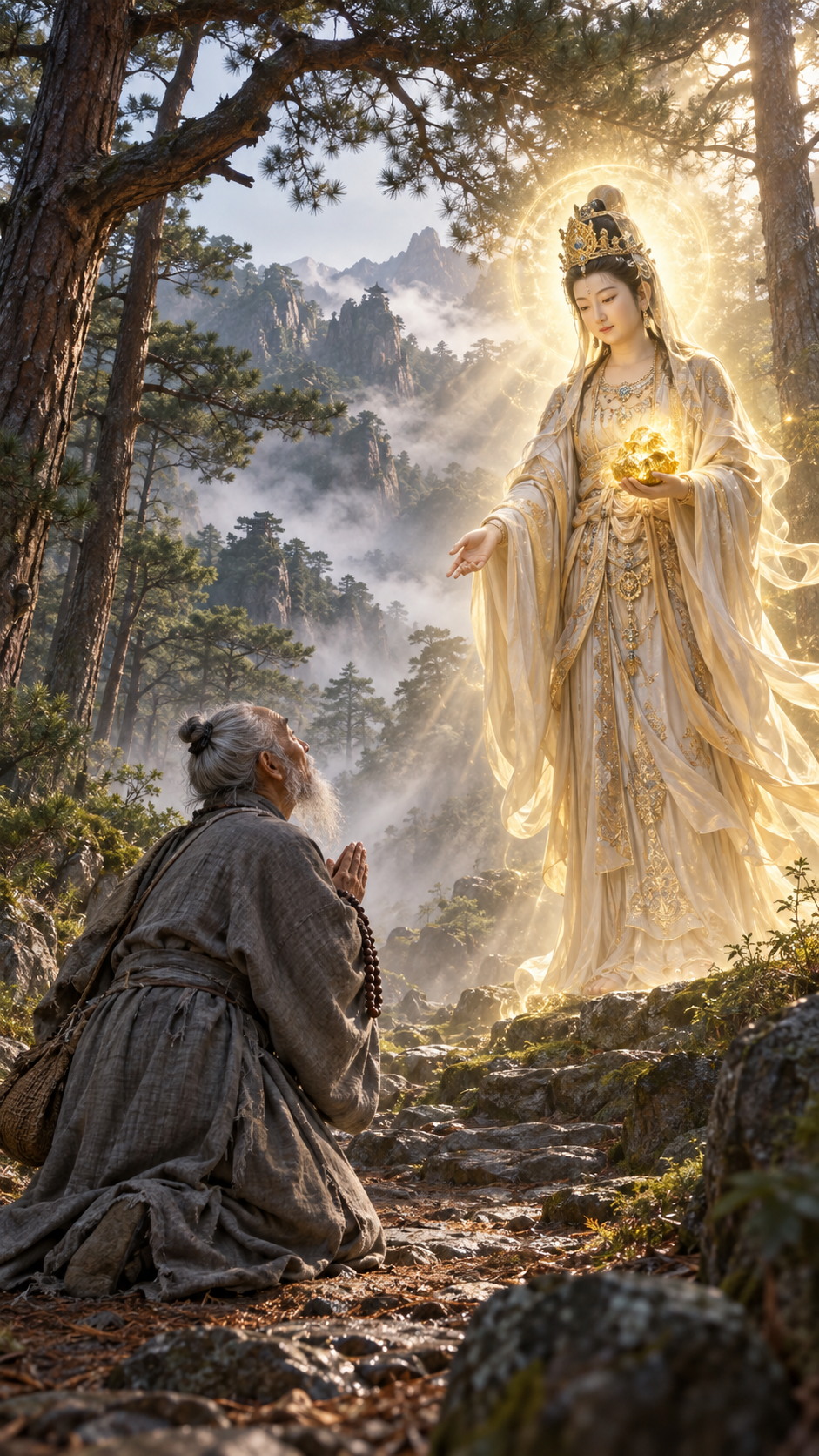
One day on a mountain path, he met a shabby old woman. Her back was bent, her clothes worn, and
nothing suggested wealth. Yet in her hands was a large lump of gold.
She offered it to the monk.
Yeonhoe was startled. Why would such a poor-looking woman possess so much gold?
Was she testing him, or awakening greed in his heart?
Without hesitation, he cast it away.
Was Rejecting Gold Truly Enlightenment?
At first, his action seems admirable. Buddhist monks leave ordinary possessions behind, so refusing gold
appears to prove that he had conquered greed. But the old woman did not praise him.
She asked why he had thrown it away.
Her question reached deeper than the metal. Yeonhoe had already judged gold to be impure and dangerous.
To him, holiness belonged to an empty hand and corruption to a hand holding treasure.
The old woman challenged that simple division. Gold itself was neither greedy nor compassionate.
In selfish hands, it could feed desire. In compassionate hands, it could feed the hungry, build a temple,
or relieve suffering.
Perhaps Yeonhoe had escaped attachment to gold—but was he attached to the image of himself as a monk
who rejected it?
That question struck his heart like a temple bell.
The Old Woman Reveals Her True Form
As Yeonhoe looked again, the old woman was surrounded by a mysterious radiance.
Her worn appearance dissolved into sacred light. She was no ordinary traveler.
She was Avalokitesvara, the Bodhisattva of Compassion, known in Korea as Gwaneum Bosal or Gwanse-
eum Bosal.
Avalokitesvara is believed to hear the cries of suffering beings and appear in whatever form can best guide
them—not only as a figure seated on a lotus, but as a beggar, a farmer, or an elderly woman whom others
ignore.
Yeonhoe bowed deeply. The true miracle was not the divine light, but that his fixed judgment had broken open.
He understood that practice was not simply running away from the world. It meant entering the world without
being ruled by greed, pride, or fear. A pure heart could touch gold without becoming its servant.
Why Avalokitesvara Appeared as a Poor Old Woman
In Korean Buddhist legends, sacred beings often appear in humble forms. If we respect only the beautiful,
powerful, and well dressed, we may fail to recognize wisdom standing directly before us.
The old woman looked poor, yet carried treasure. She appeared weak, yet awakened a respected monk.
Avalokitesvara did not lecture Yeonhoe from the sky; she met him on the road and used one simple object
to reveal his hidden attachment. This is the Buddhist idea of “skillful means”—teaching in the form best
suited to a person’s mind.
The Gold We Carry Today
For modern readers, the gold can symbolize success, talent, reputation, technology, or influence.
None is automatically good or evil. The deeper question is: Who is using whom?
Do we control what we possess, or does it control us? Do we reject the world to protect our pride, or use
what we have to help others? When truth comes from someone unimpressive, are we humble enough to listen?
Yeonhoe threw away the gold because he wanted freedom from desire. Avalokitesvara appeared to show him
an even greater freedom—the ability to face the world without clinging to it or running from it.
That is why this ancient Korean tale still feels surprisingly modern. Enlightenment is not measured by how
far we stand from gold. It is revealed by what happens inside our hearts when gold is placed in our hands.
Sometimes the greatest treasure is not the object we receive, but the illusion we finally let go.
'Korean Buddhism and Spirituality' 카테고리의 다른 글
| The One Lamp That Would Not Go Out: The Buddhist Story of the Poor Woman’s Lamp (1) | 2026.09.06 |
|---|---|
| The Otter That Changed a Man’s Life: The Buddhist Legend of Monk Hyetong (0) | 2026.09.06 |
| One Cry at the Edge of a Cliff: “Gwanseum Bosal” (0) | 2026.09.05 |
| The Poor Boy Who Built Bulguksa and Seokguram (0) | 2026.09.03 |
| The Dream of Josin: He Lived a Lifetime in a Single Night (0) | 2026.08.27 |


