He left home in the morning.
When he returned, everyone he loved had been dead for generations.
Imagine walking into a forest one morning, watching two mysterious old men play a board game,
and returning home a few hours later.
But something is terribly wrong.
Your house is gone.
Your neighbors are strangers.
Your wife and children have disappeared.
And when you ask what happened, someone tells you:
"That family lived here a hundred years ago."
It sounds like the beginning of a science fiction movie about time travel.
But this extraordinary story comes from an ancient East Asian legend that is also familiar in Korea.
In Korean, there is a famous saying:
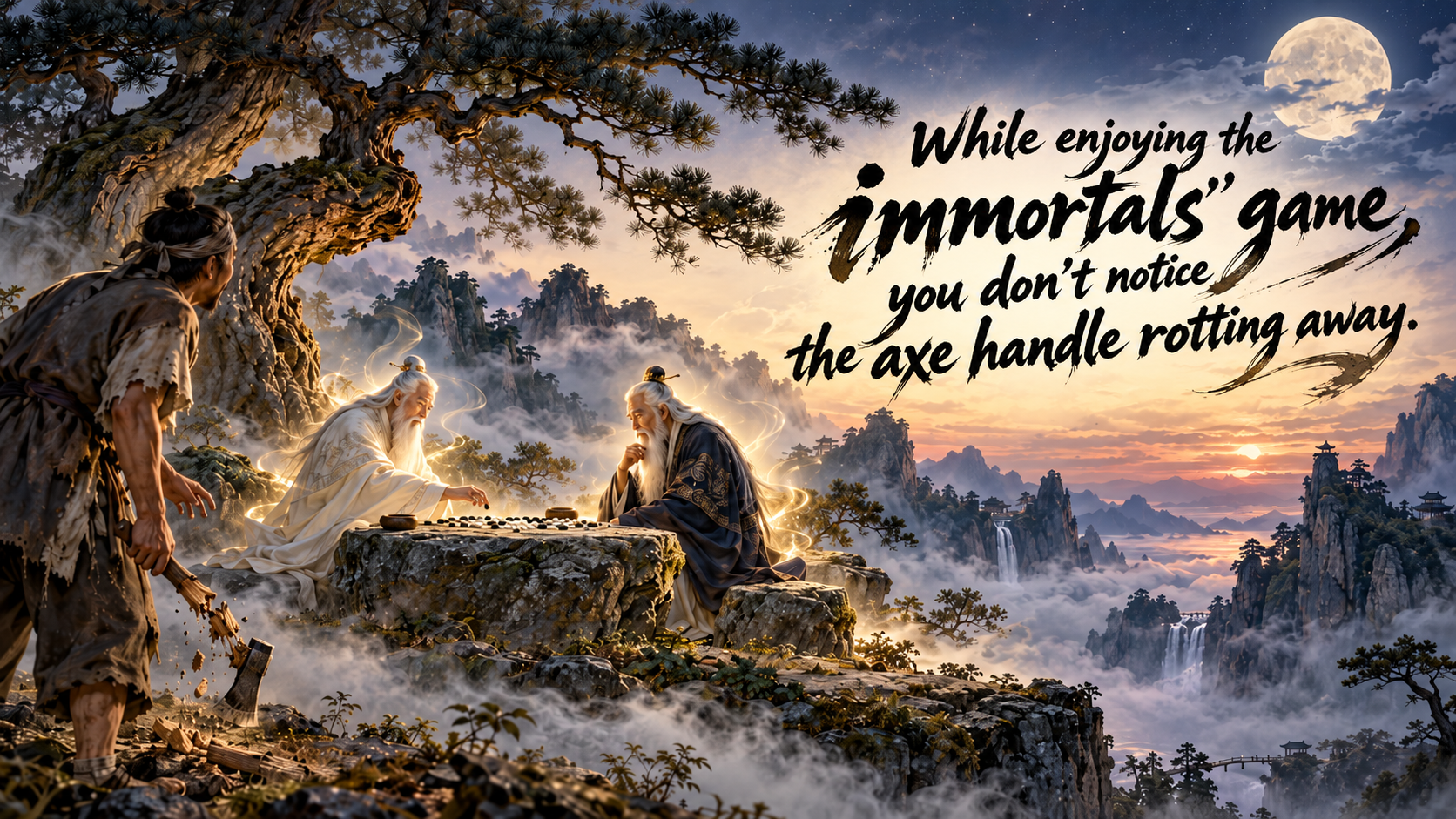
"Even the handle of your axe rots away while you're enjoying the immortals' game."
What does that mean?
To understand it, we must journey deep into a mysterious mountain where time itself seems to stand still.
1. A Poor Woodcutter and His Little Family
Long ago, in a small mountain village, there lived a poor woodcutter.
He owned almost nothing.
His little thatched-roof cottage was old, his clothes were worn, and his only valuable possession was an axe.
But he considered himself a fortunate man.
He had a loving wife, an elderly mother, and a little boy who had just begun to speak in complete sentences.
Every evening, the family gathered around a small wooden table and shared a simple meal.
Sometimes there was barely enough food.
Still, their home was filled with laughter.
One beautiful autumn morning, the woodcutter prepared to leave for the mountains.
His wife handed him a small lunch basket.
"Please come home early today," she said. "Our son has been waiting all morning to play with you."
The little boy ran toward his father.
"Daddy! Will you make me a wooden spinning top?"
The woodcutter laughed and gently ruffled his son's hair.
"Of course! I'll make you the best spinning top in the whole village!"
"Promise?"
"I promise. I'll be home before sunset."
The little boy waved goodbye.
His wife smiled from the doorway.
And the woodcutter walked toward the mountain.
He had no idea that he would never see that morning again.
2. Two Strange Old Men in the Forest
That day, the woodcutter traveled farther into the mountains than usual.
The forest was beautiful.
Maple leaves glowed red and gold, birds sang among the branches, and a clear stream flowed over
smooth stones.
Everything seemed peaceful.
Then, suddenly, he heard laughter.
"Ha! That's an excellent move!"
"Don't celebrate yet. The game isn't over!"
The woodcutter stopped.
Who could possibly be playing a game this deep in the wilderness?
Curious, he followed the voices.
Soon he came to a clearing beneath an enormous pine tree.
There, sitting across from each other on a large flat rock, were two elderly men.
One wore flowing white robes.
The other wore a pale blue robe.
Between them stood a beautiful wooden board covered with black and white stones.
They were playing Go.
Go, known as baduk in Korean, is an ancient strategy game in which two players place black and white
stones on a grid, trying to surround territory and capture their opponent's stones.
The woodcutter watched in fascination.
The old men seemed perfectly ordinary at first.
But then he noticed something strange.
The wind moved through the trees, yet their robes remained still.
Birds flew overhead, but their shadows never seemed to cross the stone.
The entire clearing felt strangely removed from the rest of the world.
One of the old men looked up.
"Young man, do you enjoy Go?"
"A little, sir," the woodcutter replied.
"Then come closer. Watch a game with us."
The woodcutter hesitated.
He still had plenty of work to do.
But surely watching a few moves wouldn't hurt.
He set down his axe.
And sat beside the board.
3. The Game That Stopped Time
Click!
A black stone landed on the board.
Click!
A white stone followed.
The sound echoed through the forest like tiny bells.
The woodcutter had seen people play Go before.
But never like this.
Every move was astonishing.
Every response revealed a new possibility.
He leaned closer.
The men smiled quietly as they played.
After a while, the woodcutter began to feel hungry.
The old man in blue offered him a tiny fruit.
"Here. Keep this in your mouth, and you won't feel hungry."
It looked like a date seed.
The woodcutter accepted it politely.
A wonderful sweetness filled his mouth.
His hunger disappeared.
So did his thirst.
He returned his attention to the board.
Something extraordinary began to happen.
With every move, the world around him seemed to change.
Fresh green leaves appeared on the trees.
Then golden leaves fluttered to the ground.
Snowflakes danced through the air.
A moment later, spring flowers blossomed again.
But the woodcutter barely noticed.
He was completely absorbed in the game.
Minutes passed.
Or perhaps hours.
He could no longer tell.
To him, the world beyond the board had simply ceased to exist.
4. The Axe That Turned to Dust
At last, the old man in white placed his final stone.
Click.
"Well, my friend," he said, "our game is finished."
The old man in blue nodded.
Then both men looked toward their visitor.
"Young man, shouldn't you be going home?"
The woodcutter suddenly remembered his family.
"Oh no! My wife must be waiting!"
He jumped to his feet and reached for his axe.
But the moment he touched its wooden handle—
CRACK!
The handle broke apart.
The wood crumbled into dry, rotten fragments.
The woodcutter stared in disbelief.
"What happened to my axe?"
That very morning, its handle had been strong and solid.
Now it looked as though it had been abandoned in the forest for a hundred years.
He turned to the old men.
"Please! Tell me what's happening!"
The man in white studied him with gentle, sorrowful eyes.
"Young man, time does not pass in the same way everywhere."
"What do you mean?"
"A short moment in the realm of immortals may be many years in the world of humans."
The woodcutter felt a chill run down his spine.
"How many years?"
The old man lowered his eyes.
"You will understand when you return home."
Before the woodcutter could ask another question, a white mist drifted across the clearing.
The two old men vanished.
The Go board disappeared.
Even the stones were gone.
Only the broken remains of his axe lay on the ground.
Terrified, the woodcutter ran down the mountain.
5. The Village That No Longer Remembered Him
He ran until he could see the roofs of his village.
But then he stopped.
Something was wrong.
The hills were familiar.
The stream still flowed along the same path.
Yet everything else had changed.
The old village tree had grown enormous.
Houses stood in unfamiliar places.
The road was wider.
Even the fields looked different.
He hurried toward his cottage.
But his home was gone.
In its place stood a large house with a tiled roof.
He knocked desperately on the door.
An elderly man opened it.
"Can I help you?"
"Yes! Please! Where is the little cottage that used to stand here?"
The old man frowned.
"What cottage?"
"My home! I live here with my wife, my mother, and my little son!"
The stranger shook his head.
"I've lived in this village for eighty years. I don't know anyone like that."
The woodcutter's voice trembled.
"That can't be true! I left this house this morning!"
The old man stared at him.
Then a distant memory seemed to stir.
"Wait..."
He paused.
"My grandfather once told me a strange story."
"What story?"
"Long ago, a young woodcutter went into the mountains and never returned."
The woodcutter felt his heart stop.
"He had a wife and a little boy," the old man continued. "They waited for him for years."
"What happened to them?" the woodcutter whispered.
"His wife grew old. The boy became a man. Then he too grew old."
The woodcutter could hardly breathe.
"And... where is the boy now?"
The old man answered softly.
"He died many years ago."
The woodcutter fell to his knees.
His little boy.
The child who had asked for a wooden spinning top.
The child who had waved goodbye just that morning.
He had grown up.
Lived an entire life.
And died waiting for a father who never came home.
For the woodcutter, only an afternoon had passed.
For everyone he loved, a hundred years had gone by.
6. The Promise That Could Never Be Kept
The villagers showed him an old burial ground on a quiet hillside.
There, among the trees, stood several weathered gravestones.
The writing had almost disappeared.
The woodcutter knelt before the grave of his son.
He reached out and touched the cold stone.
"My boy..."
His voice broke.
"Daddy's home."
There was no answer.
Only the wind moving through the grass.
"I promised you a spinning top, remember?"
Tears streamed down his face.
"I said I'd come home before sunset."
He lowered his head.
"I'm sorry, my son."
For a long time, he remained beside the grave.
He had spent the afternoon watching a beautiful game.
But the price of that afternoon had been everything he loved.
As the sun began to set, he finally stood.
And slowly made his way back toward the mountain.
7. What Is the Value of Eternal Life?
The woodcutter climbed until he reached the clearing where the two immortals had played their mysterious
game.
But the rock was empty.
The men were gone.
The board had vanished.
Only the old pine tree remained, whispering in the evening wind.
He sat beneath its branches.
For the first time, he understood something.
People dreamed of becoming immortals.
They dreamed of living forever, escaping sickness, growing old, and death.
But what was the value of eternal life if everyone you loved had disappeared?
He looked toward the distant village.
"What good is a thousand years," he whispered, "if I cannot spend even one more afternoon with my child?"
The mountain was silent.
Then a gentle breeze touched his face.
It almost sounded like a voice.
"Time is not the greatest treasure a person possesses."
The woodcutter closed his eyes.
"The greatest treasure is the love we share while time is still ours."
Above him, stars began to shine.
No one in the village ever saw the woodcutter again.
Some believed he had joined the immortals.
Others believed he had wandered deeper into the mountains, searching for the world he had lost.
But perhaps the truth no longer mattered.
His story lived on.
8. The Korean Saying About the Rotten Axe Handle
Koreans have a traditional proverb:
신선놀음에 도낏자루 썩는 줄 모른다.
Sinseon-noreume dokkijaru sseongneun jul moreunda.
It literally means:
"While enjoying the immortals' game, you don't even notice your axe handle rotting away."
In everyday Korean, people use this expression when someone becomes so absorbed in something
enjoyable that they completely lose track of time.
You might hear it when someone spends an entire afternoon playing games, chatting with friends, or enjoying
a favorite hobby.
But behind this lighthearted expression lies a surprisingly powerful lesson.
Time does not wait for anyone.
When we are children, summer vacation seems endless.
When we are young, we believe we have all the time in the world.
We imagine that our parents will always be there, our children will always be small, and the people we love
will always be waiting for us.
Then, almost without noticing, the years pass.
Our parents grow old.
Our children become adults.
Old friends drift away.
And one day, we look back and wonder:
"Where did all those years go?"
Perhaps all of us are standing beside an invisible Go board.
Some of us are absorbed in making money.
Others chase success, recognition, or power.
And still others become lost in worries about a future that has not yet arrived.
Meanwhile, the wooden handles of our axes are quietly growing old.
9. What Modern Life Can Learn from an Ancient Legend
The remarkable thing about this story is how modern it feels.
Long before science fiction imagined time travel, parallel worlds, or different experiences of time, storytellers
were already asking an extraordinary question:
What if time could pass differently in two worlds?
Of course, the legend is not a scientific explanation of time travel.
It is an imaginative story about the mystery of time and the fragile nature of human life.
But its emotional truth is timeless.
We can never be certain how much time remains.
A simple dinner with family may one day become a cherished memory.
A short walk with a parent may become something we wish we could experience just once more.
A child's laughter, a friend's smile, or an ordinary conversation may turn out to have been among the most
precious moments of our lives.
The woodcutter lost a hundred years.
Most of us will never experience anything so dramatic.
And yet we often lose something just as precious.
We lose the present moment while worrying about tomorrow.
We forget to appreciate the people sitting beside us.
We postpone kindness.
We delay apologies.
We assume there will always be another chance.
But some moments never return.
10. A Thousand Years of Life, or One Day of Love?
If someone offered you a choice, what would you choose?
To live for a thousand years without growing old?
Or to spend one more beautiful day with someone you deeply love?
The woodcutter's story asks us to think carefully about that question.
Perhaps a meaningful life is not measured by how long we live.
Perhaps it is measured by how deeply we love.
How sincerely we care.
How fully we experience the ordinary moments that make life beautiful.
The immortals may have possessed endless time.
But the woodcutter once possessed something even more precious.
A home filled with laughter.
A wife waiting at the door.
A little boy asking his father to make him a spinning top.
He understood the value of those things only after they were gone.
We still have the chance to understand them today.
Final Reflection: The Most Precious Move in the Game of Life
Life is often compared to a game of Go.
Every day, we place another stone on the board.
Some moves bring success.
Others bring disappointment.
Some we celebrate.
Others we regret.
But when the game of life finally ends, perhaps the most important thing will not be how many battles we won.
It will be the people who sat beside us along the way.
The ancient story of the immortals' Go game reminds us of a simple truth:
A thousand years of immortality may be worth less than a single beautiful day spent with
someone we love.
So call someone you miss.
Tell your family you love them.
Thank an old friend.
Hold your child's hand.
And never forget that today is a day you will never be able to live again.
Somewhere, deep in a mysterious mountain, the immortals may still be playing their endless game.
But here in our world, the greatest treasure is not eternal life.
It is the precious, fleeting moment we are living right now.


