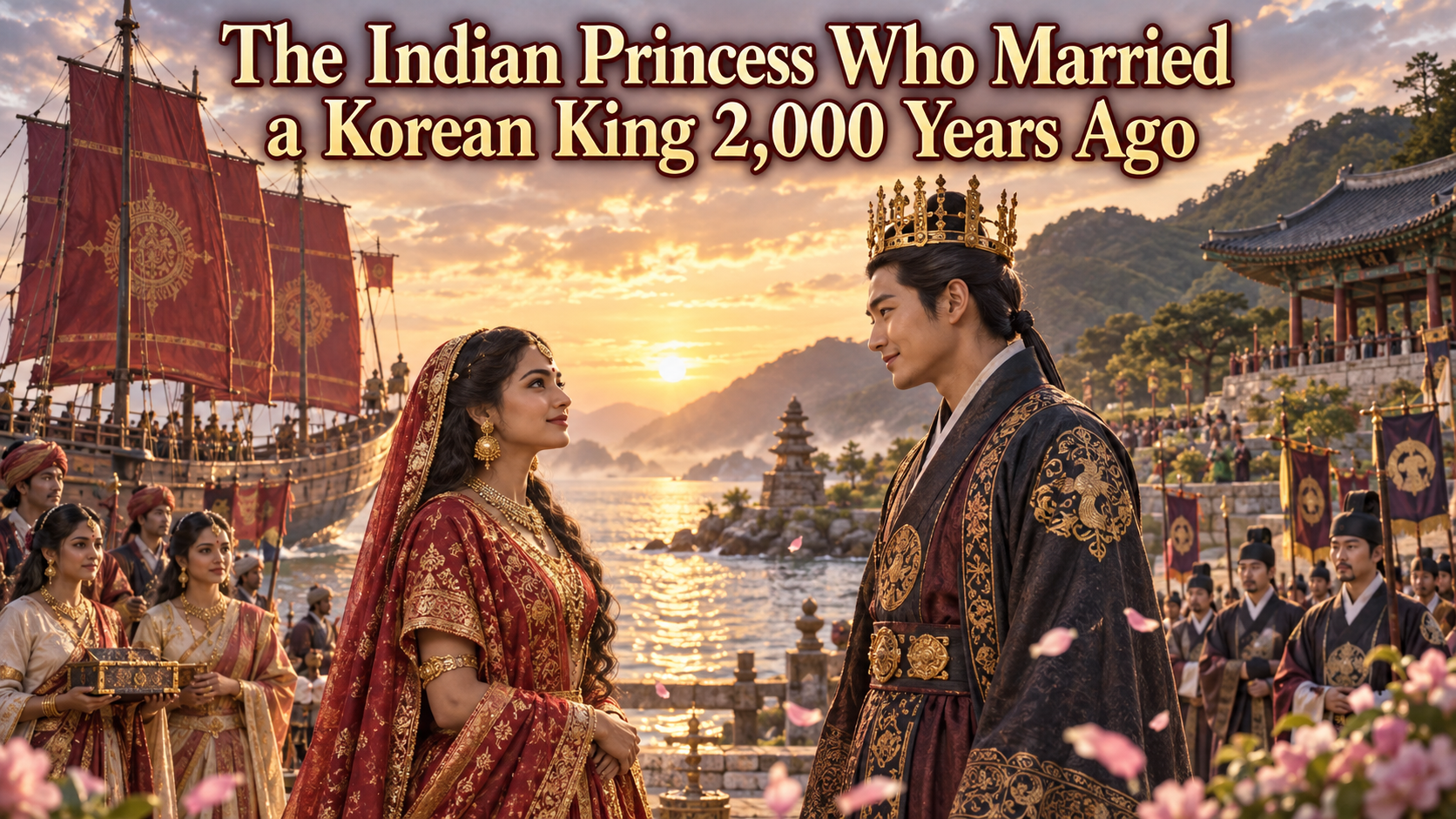
The Remarkable Legend of Queen Heo Hwang-ok
Nearly two thousand years ago, a teenage princess is said to have boarded a wooden ship and sailed across
a dangerous sea. She left a distant kingdom called Ayuta and traveled toward Garak, an ancient state in the
southern part of the Korean Peninsula.
Her name was Heo Hwang-ok. According to the legend, she was only sixteen years old. She was not traveling
for adventure or trade. She was crossing the sea to marry a king she had never met.
There were no airplanes, satellite maps, or weather forecasts. A voyage depended on the wind, the stars, and
the experience of sailors. Why would a young princess risk everything for an unknown country?
Her story, recorded in Korea’s medieval historical collection Samguk Yusa, still stands between history and myth.
A Divine Message in a Dream
The story appears in the “Garakgukgi” section of Samguk Yusa, compiled by the Buddhist monk Iryeon in the
thirteenth century.
One night, the king and queen of Ayuta received a divine message in a dream. They were told that King Suro
of Garak had founded a new kingdom but had not yet chosen a queen. Their daughter was destined to travel
east and become his wife.
When her parents told her about the dream, Princess Heo accepted the extraordinary journey.
She reportedly boarded a ship with attendants, servants, silk, precious objects, and other gifts.
Imagine the moment when the red sails disappeared beyond the horizon. Her parents could not send her a
message or track her voyage. Princess Heo must also have hidden fear and homesickness behind her brave
expression.
The Mysterious Stone That Calmed the Sea
A strange stone plays an important role in the legend. Princess Heo’s first attempt to cross the sea was blocked
by violent winds and waves, forcing her ship to turn back.
Her parents then placed special stones aboard the vessel. These stones were believed to calm the sea and
protect the travelers. With the stones on board, the ship finally completed its journey.
The stones are traditionally associated with the Pasaseok Pagoda at Queen Heo’s tomb in modern Gimhae.
The small pagoda, made of unusual reddish stone, has long been treated as a symbol of her voyage.
It has not been scientifically proven that the stones arrived on her ship.
Perhaps heavy stones used for balance and religious prayers for a safe journey gradually became one
miraculous story. Either way, the image is unforgettable: a red-sailed ship, a raging ocean, and a mysterious
stone glowing in the darkness.
A Red Sail Appears on the Gaya Coast
According to Samguk Yusa, the princess reached Garak in 48 CE. One can imagine the excitement along the
coast. Children pointed toward an unfamiliar ship, merchants stared at its foreign goods, and royal officials
hurried to inform King Suro.
“Where did that enormous ship come from?”
The king sent attendants to welcome the royal visitor. Yet Princess Heo did not rush directly to the palace.
The record says that she went to a high place, changed out of the clothes she had worn during the voyage,
and then prepared to meet the king.
This may have been a ritual of purification and transition. It also reveals a dignified woman who maintained
her own customs and royal identity even after arriving in an unfamiliar land.
“I Crossed the Sea to Meet You”
Princess Heo finally stood before King Suro and introduced herself. She explained that she was the princess
of Ayuta and had followed the divine instructions given to her parents.
King Suro replied that his officials had repeatedly encouraged him to choose a queen, but he had refused
because he believed heaven would send the right woman.
One person had crossed the sea to find her destiny; the other had waited for that destiny to arrive.
They married, and Heo Hwang-ok became the queen of Geumgwan Gaya. The tradition says that they had
ten sons and two daughters. Some sons were allowed to inherit their mother’s family name, Heo.
Even today, many members of the Gimhae Kim and Gimhae Heo clans regard King Suro and Queen Heo
as their ancestors.
Thus, the voyage of one princess has survived not only in books and monuments but also in the family
histories of countless Koreans.
Did She Really Come from India?
The greatest mystery concerns the location of Ayuta. Because the name resembles Ayodhya, an ancient city
in northern India, Heo Hwang-ok is widely described as an Indian princess. Gimhae and Ayodhya have also
developed cultural ties based on this shared story.
However, scholars continue to debate where Ayuta was and whether Queen Heo was a historical person.
It is safer to describe her Indian origin as a beloved tradition recorded in Samguk Yusa, not as a conclusively
proven fact.
That does not mean the story has no historical background. Geumgwan Gaya developed near the mouth of
the Nakdong River and the ancient Gimhae Bay, an ideal location for maritime trade.
Archaeological sites have yielded objects showing contact with China, the Japanese archipelago, northern
regions, and other distant networks. Boat-shaped pottery, foreign-style glass, and elaborate ornaments reveal
a society connected to the wider world.
Queen Heo’s legend may therefore preserve a cultural memory of people and ideas arriving in Gaya by sea.
Gaya Was a Kingdom Open to the Sea
Gaya is often called the “Kingdom of Iron.” Its people developed advanced ironworking skills and traded iron,
tools, weapons, and other goods. Foreign merchants and sailors may once have gathered at its busy ports.
For the people of Gaya, the sea was not the end of their world. It was a road leading toward unfamiliar cultures.
In such a society, a story about a foreign-born queen does not seem entirely out of place.
We cannot identify everything Queen Heo may have brought to Korea. Yet her story reminds us that people
in ancient Korea imagined and experienced a world much larger than their own villages and kingdoms.
A Courage More Precious Than Gold
Queen Heo’s story remains moving not simply because it resembles an international royal romance.
At its heart is the courage of a young woman who chose to enter the unknown.
She left her family and homeland, crossed a sea that could turn deadly without warning, and began a new
life among people with different customs and perhaps a different language.
The princess in this legend does not wait helplessly to be rescued. She steps onto the ship and moves toward
her own fate.
Her meeting with King Suro is also meaningful. He waits for a partner chosen by heaven, while she approaches
him with dignity and her own story. Their marriage represents two worlds meeting rather than one simply
conquering the other.
Between Myth and History
Did Princess Heo’s ship truly sail from India? Did the mysterious stones calm a storm? We still do not know.
Legends, however, are not valuable only when every detail can be proven. They preserve the hopes, fears,
and memories of the people who told them. Queen Heo’s story contains memories of a maritime Gaya, an
open society that welcomed someone from across the sea, and a courageous woman who traveled toward
an uncertain future.
Visitors to Queen Heo’s tomb in Gimhae can still see the Pasaseok Pagoda. Standing before those weathered
stones, it is easy to imagine red sails in a storm, a distant shore, and the first meeting between the princess
and the king.
The most precious treasure she carried was probably not gold or silk. It was the courage to move forward
despite fear, the openness that connected different cultures, and a story powerful enough to cross two
thousand years and reach us today.
'Korean History and Symbols' 카테고리의 다른 글
| Did the People of Gaya Ride Ducks into the Afterlife? (0) | 2026.09.16 |
|---|---|
| Why Is King Sejong So Respected in Korea? (0) | 2026.07.30 |
| 돌릴 수 없는 세월(“The Irretrievable Years”) Song by Cho Hang Jo (1) | 2026.04.30 |
| 시절인연(Fate in Time) Song by Soo Yeon Lee (0) | 2026.02.25 |
| '붓' 천재 소년 황민호의 트롯에 반하다.("Falling for the Trot of Genius Boy Hwang Min-ho with 'Brush'') (1) | 2025.09.24 |


