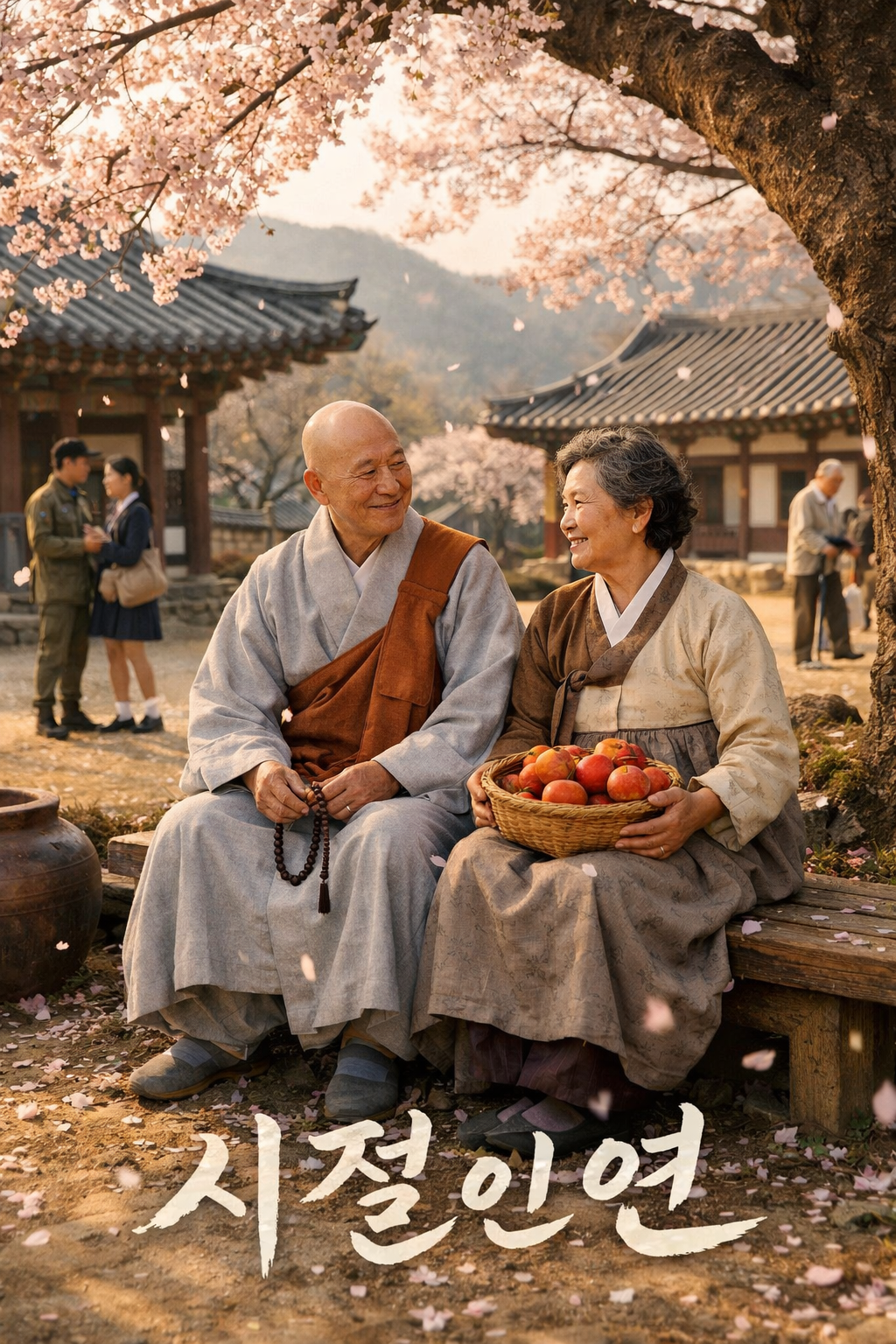
우연히 유튜브를 보다 '시절인연' 이란 단어가 귀에 들어 와 자세히 살펴보니 미소천사라
불리우는 소녀가 노래를 부르는데 너무나 마음에 와 닿는 잔잔하지만 여운이 남는 명곡이었다.
사실 '시절인연'이란 문구는 불교 방송에서 자주 접하는 말이지만 그 어린 소녀가 눈을 감고
조용히 애절하게 부르는 이 노래는 어느 고승이 상처받은 중생에게 보내는 위로의 법문이었다.
While I was casually watching YouTube, the word “sijeol inyŏn” (시절인연, the karma of time and
conditions) caught my ear. I looked into it more closely and found a girl known as the
“Smiling Angel” singing a song. It was quiet yet deeply moving, a masterpiece that lingered in my heart.
In fact, the phrase “sijeol inyŏn” is something I often hear on Buddhist broadcasting, but the way that
young girl, eyes closed, sang the song so quietly and poignantly made me realize it was actually a
Dharma teaching of comfort, sent by a great master to wounded sentient beings.
'시절인연'이란 무엇인가? 그속에 담겨있는 깊은 뜻도 함께 알아보는 시간이 되기를 바랍니다.
What is “sijeol inyŏn”? I hope this can be a chance to learn the deeper meaning contained within it.
시절인연(時節因緣) — 때가 오면 꽃은 스스로 핀다
Sijeol Inyŏn (時節因緣) — When the time comes, the flower blooms on its own
봄이 오면 매화는 말없이 꽃을 틔웁니다.
억지로 당겨서 피는 꽃도 없고요.
우리가 자주 쓰는 말, ‘시절인연’은 바로 이 자연의 이치를 닮은 말입니다.
인연도, 기회도, 깨달음도 ‘때’가 무르익어야 열린다는 뜻이지요.
When spring comes, the plum blossoms open in silence.
There is no flower that blooms because we force it to.
The expression we often use, “sijeol inyŏn,” resembles this law of nature.
It means that karmic connections, opportunities, and even enlightenment open only when
the “time” is fully ripe.
1. 시절인연의 유래 — 불경에서 온 말
The Origin of Sijeol Inyŏn — A Term from the Buddhist Scriptures
‘시절인연(時節因緣)’은 불교 경전에서 비롯된 말입니다.
특히 대승불교 경전인 화엄경 과 선불교 어록에서 자주 등장합니다.
“Sijeol inyŏn (時節因緣)” is a term that comes from Buddhist scriptures.
It appears frequently in Mahayana texts such as the Avataṃsaka Sūtra (Flower Garland Sūtra)
and in Chan (Seon/Zen) Buddhist sayings.
불교에서 ‘인연(因緣)’은 단순한 만남이 아닙니다.
모든 존재는 수많은 원인(因)과 조건(緣)이 모여 이루어진다는 뜻입니다.
그리고 여기에 ‘시절(時節)’, 즉 적절한 시간이 더해집니다.
In Buddhism, “inyŏn” (因緣, causes and conditions) does not simply mean a casual encounter.
It means that every existent thing is formed through the gathering of countless causes (因) and
conditions (緣). To this is added “sijeol” (時節), that is, the appropriate time.
“因緣時節이 도래하면 과(果)가 성숙한다.”
— 인연과 시절이 갖추어지면 결과가 맺힌다.
“When the time and conditions of cause and condition arrive, the fruit ripens.”
— When causes, conditions, and the right time come together, a result is produced.
이 사상은 **석가모니**의 가르침, 즉 **연기법(緣起法)**에서 비롯됩니다.
연기법이란 “이것이 있으므로 저것이 있고, 이것이 없으면 저것도 없다”는 존재의
상호 의존 법칙입니다.
This idea originates in the teaching of Śākyamuni Buddha, namely the doctrine of dependent
origination (緣起法, yeongi-beop).
Dependent origination is the law of mutual interdependence of existence: “Because this exists,
that exists; if this does not exist, that also does not exist.”
씨앗이 있어도
흙과 물과 햇빛과 시간이 없으면
꽃은 피지 않습니다.
이것이 바로 시절인연입니다.
Even if there is a seed, if there is no soil, water, sunlight, and time, the flower will not bloom.
This is exactly what “sijeol inyŏn” is.
2. 선불교에서 말하는 시절인연
Sijeol Inyŏn in Seon (Zen) Buddhism
선종에서는 이런 말을 합니다.
“인연이 무르익으면 부처도 나타난다.”
In the Seon tradition, there is a saying:
“When the karmic conditions ripen, even a Buddha will appear.”
대표적인 선사로 알려진 **혜능**의 가르침에서도
깨달음은 억지 수행으로 오는 것이 아니라
‘마음이 준비되었을 때’ 문득 열린다고 합니다.
In the teachings of Huineng, a representative Seon master, it is said that enlightenment does
not come through forced practice, but suddenly opens when the mind is ready.
수행을 오래 했다고
모두 깨닫는 것은 아닙니다.
어떤 이는 하루 만에 깨닫고,
어떤 이는 십 년이 걸립니다.
이 차이를 만드는 것이 바로 ‘시절’입니다.
Not everyone attains enlightenment just because they practice for a long time.
Some awaken in a single day, while others take ten years.
What creates this difference is precisely “sijeol,” the right time.
3. 옛 고전 속의 시절인연
Sijeol Inyŏn in the Old Classics
불교뿐 아니라 동양 고전에서도 비슷한 가르침이 나옵니다.
**주역**에서는
‘때(時)’를 아는 것을 지혜라 했습니다.
Teachings similar to this are found not only in Buddhism but also throughout the classics
of the East. In the I Ching (Book of Changes), to know the “time (時)” is called wisdom.
“군자는 시를 따른다.”
— 군자는 하늘의 때를 살핀다.
“The noble person follows the time.”
— A noble person observes the timing of Heaven.
억지로 밀어붙이면 흉(凶)이 되고
때를 기다리면 길(吉)이 됩니다.
If you push things forward by force, it brings misfortune (凶),
but if you wait for the right time, it becomes auspicious (吉).
또한 조선의 고전 문학 속에서도
“꽃은 철을 어기지 않는다”는 표현이 자주 등장합니다.
In classical Joseon literature as well,
the expression “flowers do not go against their season” appears often.
사람의 인연도
꽃처럼 피고 지는 때가 있다는 뜻입니다.
This means that human relationships, too,
have their own time to bloom and wither, just like flowers.
4. 시절인연의 깊은 뜻 — 기다림의 철학
The Deeper Meaning of Sijeol Inyŏn — A Philosophy of Waiting
시절인연은 단순히 “운명”을 말하는 것이 아닙니다.
그 안에는 세 가지 깊은 뜻이 있습니다.
Sijeol inyŏn is not simply talking about “fate.”
Within it, there are three deeper meanings.
① 억지로 만들지 말라
모든 것은 준비가 갖추어져야 성숙합니다.
관계도, 사업도, 사랑도 마찬가지입니다.
① Do not force things
Everything ripens only when the preparations are complete.
It is the same for relationships, for business, and for love.
② 지금의 시간도 인연이다
지금 만나지 못했다고 해서
인연이 아닌 것이 아닙니다.
지금은 아직 ‘시절’이 아닐 뿐입니다.
② This present time is also part of the karmic conditions
Just because you have not met (someone or something) now
does not mean there is no karmic connection.
It is only that “the time” has not yet come.
③ 때가 되면 반드시 열린다
씨앗은 썩는 것처럼 보여도
땅속에서 준비를 합니다.
우리 인생의 정체기 또한
뿌리를 내리는 시간일지 모릅니다.
③ When the time comes, it will surely open
Even when a seed looks as if it is rotting,
it is preparing itself beneath the ground.
The stagnant periods in our lives, too,
may actually be the time when our roots are growing deeper.
5. 사랑과 시절인연
Love and Sijeol Inyŏn
우리는 종종 묻습니다.
“왜 그 사람은 떠났을까?”
“왜 나는 아직 혼자인가?”
We often ask,
“Why did that person leave?”
“Why am I still alone?”
불교에서는 이렇게 말합니다.
“인연이 다하면 흩어지고,
인연이 모이면 다시 만난다.”
Buddhism answers in this way:
“When the karmic connection is exhausted, beings scatter;
when the karmic connection gathers again, they meet once more.”
어떤 만남은
잠시 스쳐 가는 바람이고
어떤 만남은
평생 함께하는 나무가 됩니다.
Some encounters
are a wind that brushes past for a moment,
while other encounters
become a tree that stays with you for life.
그 차이는
‘좋고 나쁨’이 아니라
시절의 차이일지도 모릅니다.
The difference between them
may not be a matter of “good or bad,”
but simply a difference in timing.
6. 현대를 사는 우리에게 주는 위로
The Consolation It Offers to Those of Us Living Today
요즘 우리는 너무 조급합니다.
성공도 빨라야 하고
사랑도 빨라야 하고
결과도 빨리 나와야 합니다.
Nowadays, we are far too impatient.
Success must come quickly,
love must come quickly,
and results must appear quickly.
하지만 시절인연은 말합니다.
“때가 되지 않으면 꽃은 피지 않는다.”
But sijeol inyŏn says:
“If the time has not come, the flower will not bloom.”
억지로 피운 꽃은 오래가지 못합니다.
자연스럽게 핀 꽃만이 향기를 냅니다.
혹시 지금 일이 잘 풀리지 않는다면
그것은 실패가 아니라
‘시절을 기다리는 시간’일지도 모릅니다.
A flower that is forced to bloom cannot last long.
Only a flower that blooms naturally gives off fragrance.
If things are not working out well for you right now,
it may not be a failure,
but rather “a time of waiting for the right season.”
7. 결국, 시절인연이란 무엇인가
So, What Is Sijeol Inyŏn, Ultimately?
시절인연은 운명론이 아닙니다.
그것은 조급함을 내려놓는 지혜이며
흐름을 믿는 태도입니다.
Sijeol inyŏn is not fatalism.
It is the wisdom of letting go of impatience
and an attitude of trusting the flow.
모든 만남에는 이유가 있고
모든 헤어짐에도 의미가 있으며
모든 기다림에도 준비가 있습니다.
Every meeting has its reason,
every parting has its meaning,
and every period of waiting is a time of preparation.
봄이 오면
매화는 스스로 피듯이
당신의 인연도
당신의 성공도
당신의 사랑도
그때가 되면
말없이 찾아올 것입니다.
When spring comes,
the plum blossoms bloom of themselves.
In the same way,
your karmic connections,
your success,
and your love,
when their time comes,
will come to you quietly, without a word.
오늘은 다만
씨앗을 심고
물을 주며
하늘을 바라보면 됩니다.
For today, it is enough
to simply plant the seed,
water it,
and look up at the sky.
그것이 바로
시절인연의 삶입니다.
That is precisely
the life of sijeol inyŏn.
그녀의 모습은 항상 미소띄운 수줍은 소녀이지만 아버님을 너무나 일찍 여의고 할머니
를 의지하며 꿋꿋하게 살면서 언젠가는 가정에 웃음이 찾아오리라는 '인연시절'의 믿음
이 그녀를 붙들어 준 것이 아닐까 생각합니다.
Though she always appears as a shy young girl with a gentle smile,
she lost her father far too early and has lived steadfastly,
relying on her grandmother.
I cannot help but think that it was her faith in “inyŏn sijeol” —
the belief that one day laughter would return to her family —
that has been holding and supporting her all this time.
그럼 미소 천사 '이수연'이 부른 '시절인연'의 가사를 음미해 보고 그녀의 노래를
감상해 보시죠.
저도 이수연의 노래를 들으며 "나의 인연시절'은 언제 올까?" 가슴 설레임으로 기다려봅니다.
Then let us savor the lyrics of “Sijeol Inyŏn,” sung by the “Smiling Angel” Lee Soo‑yeon,
and take a moment to appreciate her song.
As I listen to Lee Soo-yeon’s song, I too wait with a fluttering heart and wonder, “When will
my destined time of karmic connection arrive?”
'시절인연' 가사 English lyrics of 'shijeol inyeon'
사람이 떠나간다고 sarami tteonagandago
그대여 울지 마세요 keudaeyeo ulji maseyo
오고 감 때가 있으니 ogo gam ttaega isseuni
미련일랑 두지 마세요 miryeonillang duji maseyo
좋았던 날 생각을 하고 johatdeon nal saenggakeul hago
고마운 맘 간직을 하며 komaun mam ganjigeul hamye
아아아 살아가야지 ah ah ah saragayaji
바람처럼 물처럼 baramcheoreom mulcheoreom
가는 인연 잡지를 말고 ganeun inyeon jabjireul malgo
오는 인연 막지 마세요 oneun inyeon makji maseyo
때가 되면 찾아올 거야 ttaega doemyeon chajaol keoya
새로운 시절인연 saeroun shijeol inyeon
친구가 멀어진다고 chinguga meoreojindago
그대여 울지 마세요 keudaeyeo ulji maseyo
영원한 것은 없으니 yeongwonhan geoseun eopseuni
이별에도 웃어주세요 ibyeoredo useojuseyo
좋았던 날 생각을 하고 johatdeon nal saenggakeul hago
고마운 맘 간직을 하며 komaun mam ganjigeul hamyeo
아아아 살아가야지 ah ah ah saragayaji
바람처럼 물처럼 baramcheoreom mulcheoreom
가는 인연 잡지를 말고 ganeun inyeon jabjireul malgo
오는 인연 막지 마세요 oneun inyeon makji maseyo
때가 되면 찾아올 거야 ttaega doemyeon chajaol keoya
새로운 시절인연 saeroun shijeol inyeon
새로운 시절인연 saeroun shijeol inyeon
사람이 떠나간다고 sarami tteonagandago
그대여 울지 마세요 keudaeyeo ulji maseyo
영어 가사 내용 (English translation of the Lyrics)
Just because someone is leaving
Please don’t cry
There’s a time for coming and going
So don’t put too much heart into it
I’ll think of the good days
And cherish my thankful heart
As I live
Like the wind, like the water
Don’t hold on to what leaves
Don’t block what comes
When the time comes, people will come
It’ll be a new time, new connection
Just because a friend has gotten farther away
Please don’t cry
Nothing lasts forever
So smile, even for goodbyes
I’ll think of the good days
And cherish my thankful heart
As I live
Like the wind, like the water
Don’t hold on to what leaves
Don’t block what comes
When the time comes, people will come
It’ll be a new time, new connection
It’ll be a new time, new connection
Just because someone is leaving
Please don’t cry
'korean songs' 카테고리의 다른 글
| 돌릴 수 없는 세월(“The Irretrievable Years”) Song by Cho Hang Jo (1) | 2026.04.30 |
|---|---|
| '붓' 천재 소년 황민호의 트롯에 반하다.("Falling for the Trot of Genius Boy Hwang Min-ho with 'Brush'') (1) | 2025.09.24 |
| 독도는 한국땅(Dok-do belongs to Korea) (2) | 2025.09.01 |
| 아씨(The Lady)Song by Mi Ja Lee (3) | 2025.07.07 |
| 이등병의 편지(A Private’s Letter) Song by Kwang Seog Kim (1) | 2025.07.05 |


