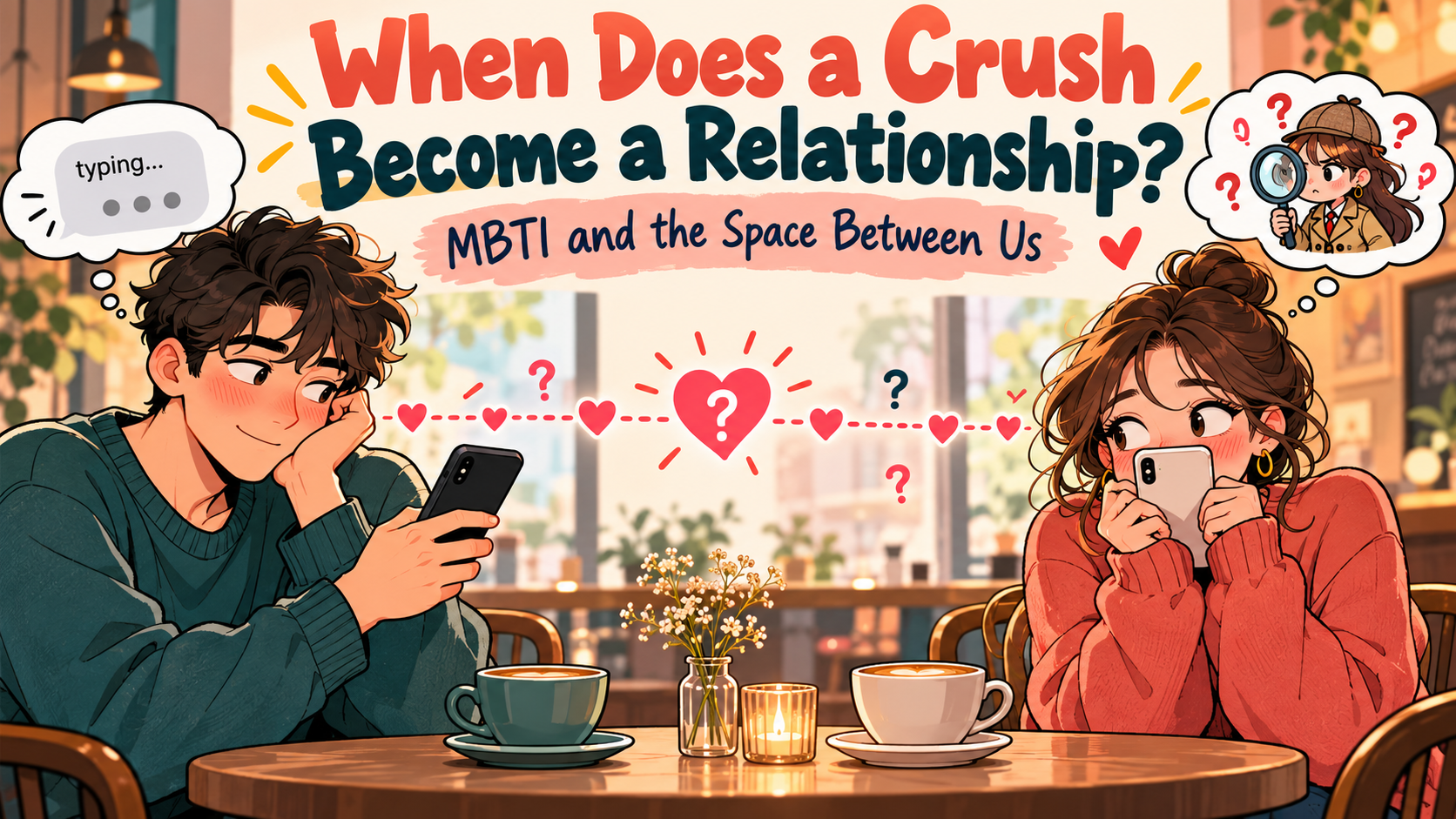
“We talked for three hours yesterday. Today, I got a one-word reply. Are we dating, or am I just imagining things?”
Most of us have been the friend asked to decode a message like this—or the person staring at the screen.
A “good night” text can make an ordinary Tuesday sparkle. A message left on read can turn us into amateur
detectives. We know how we feel, but we do not know what to call the space between friendship and a relation-
ship.
In Korea, that space has a popular name: sseom (썸). It describes a stage of mutual interest when two people
may be flirting or getting closer, but have not clearly defined their relationship. It can be delightful.
It can also be confusing, especially when one person imagines a beginning and the other simply enjoys talking.
This is where personality questions often enter the chat. “What’s their MBTI?” can feel easier to ask than
“What do they want with me?” The four letters can start a conversation about preferences. They cannot read
someone’s mind.
Let’s use them as a doorway into better questions about dating, friendship, and the distance we need from one
another.
Is there an official starting point for a relationship?
Does daily texting count? A movie together? Holding hands? A direct confession? There is no universal checklist.
One person sends daily updates to all their friends; another considers a simple invitation to dinner a bold sign of
interest. The same action can carry different meanings.
Instead of counting messages, look at three things. Is the effort mutual? Is it consistent? Can you talk about
what you each expect? A funny meme may brighten your morning, but keeping a promise, making time to meet,
and respecting a boundary reveal more about how a person treats you.
Imagine someone who sends hearts every night but postpones every plan for a month. Now imagine someone
who texts less often but remembers the exhibition you wanted to see and asks if you are free on Saturday.
We cannot know either person’s intentions from a single detail. We can, however, notice which pattern helps us
feel valued and secure.
The turning point is often quieter than a movie scene. It arrives when two people begin to make their hopes visible
to each other. “I like spending time with you. How do you see us?” is a vulnerable question, but it gives both people
room to answer honestly.
The Korean dream of meeting naturally
Another Korean expression is jaman-chu (자만추), short for “preferring to meet someone naturally.”
It captures the charm of getting to know a person through everyday life: a conversation that lasts after class,
a shared hobby, a walk that neither of you wants to end.
Meeting naturally does not mean waiting forever for coincidence to do all the work. Inviting someone for coffee
can be natural, too. So can saying, “I had fun talking today. Would you like to meet again next week?”
It is a small act of courage, not a demand for an immediate declaration of love.
The other person may say no. That answer may hurt, but it does not reduce your worth. A healthy beginning gives
both people a real choice. The invitation matters; so does the freedom to decline it.
What can MBTI tell us about love?
It is tempting to say, “They’re an introvert, so of course they never text first,” or “I’m a Thinking type, so emotional conversations aren’t my thing.” These lines can be playful. They become unhelpful when we treat them as the
final word on a person.
The familiar MBTI preferences can instead suggest useful questions. An Extraversion–Introversion difference may
show up after a busy party: does each person want more company or some quiet? Sensing–Intuition may shape
what they notice about a date: the delicious food and practical details, or the mood and possibilities it sparked.
Thinking–Feeling may affect a first response to a problem: “Here’s a solution,” or “That sounds hard.” Judging–
Perceiving may become visible when planning a weekend: book everything by Thursday, or leave room to
improvise?
These are possible preferences, not rules. An outgoing person can need a night alone.
A careful planner can love a surprise. No four-letter type tells you whether someone is kind, trustworthy, ready for commitment, or compatible with you. Nor does “That’s just my type” excuse a hurtful comment.
Try a better question: “When you have a hard day, would you like me to listen first or help solve the problem?”
It tells you more about how to care for this particular person than a compatibility chart ever could. Use personality language to explain your needs, then stay curious enough to hear theirs.
If they reply slowly, do they care less?
A read receipt can turn an ordinary afternoon into an imaginary courtroom. We gather evidence: the time stamp,
the emoji they used last week, how quickly they replied to someone else. Soon a delayed response becomes a
story about fading affection.
But speed has many explanations. Some people cannot check their phones at work. Others prefer to finish a task
before replying thoughtfully. Your disappointment still matters. You can say, “When we go a whole day without talking,
I start to feel disconnected. Could you let me know when you’re especially busy?” The other person can explain their rhythm, and you can decide together what feels reasonable.
The goal is not to win a contest for the fastest reply. It is to see whether you can hear each other and adjust.
If promises are repeatedly broken, pay attention to the pattern of behavior rather than searching for a personality
label that explains it away.
How much space keeps a relationship alive?
We often picture romance in grand gestures: a surprise trip, a perfect anniversary dinner, a speech under the rain.
Real closeness also grows through smaller moments. Remembering a presentation that mattered to someone.
Asking how it went. Listening to a story you have heard before because today it matters again.
Friendships work this way, too. Being close does not require answering every call or sharing every free hour.
A comfortable distance lets both people breathe while knowing they can reach for one another.
If you have not spoken to a friend in months, “I thought of you today. How have you been?” opens a warmer door
than “Why haven’t you called me?”
People need different amounts of company, quiet, reassurance, and independence. The healthiest distance is not identical for every pair. It is one they can discuss without making either person feel guilty for having needs.
When should you step back?
Korean speakers sometimes use sonjeol (손절), literally “cutting off,” for ending a draining relationship.
The word offers a satisfying sense of clarity. Real decisions are often less simple. One disappointing day need
not end a friendship. Repeatedly ignored boundaries, however, deserve attention.
Start by naming the behavior rather than judging the whole person.
Was a private story shared without permission? Do plans get canceled at the last minute? Are you made to feel
guilty whenever you say no? You might say, “I felt uncomfortable when you told others what I shared privately.
Please ask me before passing it on.” This gives the other person a chance to understand and change.
If they listen and make a genuine effort, the relationship may grow. If the same behavior continues, you can
create more distance. That could mean meeting less often or choosing what you share.
You do not owe anyone an elaborate breakup speech to protect your peace. When a relationship involves
threats, coercion, or violence, put your safety and support from trusted people first.
A helpful test is not “Do I like this person enough to endure everything?” Ask instead: Can I speak honestly
here? Is my “no” respected? Can we repair a mistake together? Affection matters, but mutual respect
gives it somewhere safe to live.
One question to take with you
If you are in the middle of a sseom, pause the search for ten secret signs that the other person likes you.
Ask yourself: Do I feel comfortable in this connection? Have I expressed the pace I want? Am I ready to hear
what they want, even if it differs from my hope?
If a friend or partner feels far away, consider whether you have both understood the same moment differently.
A conversation may not solve everything, but it can replace a little guessing with clarity.
The space between people cannot be measured in text messages or miles. Someone can write all day and still
feel distant; another can sit beside you in silence and make you feel at home.
MBTI offers an interesting first question. The next ones belong to the two of you: “What helps you feel close?”
“How would you like me to say this?” “What kind of relationship are we building?”
A crush may become a relationship when two people begin asking those questions with honesty and kindness.
They can take their time. The best company is someone willing to learn your pace while sharing their own.
'Korean Culture Explained' 카테고리의 다른 글
| Are We Meant to Meet? The Korean Idea of Inyeon, from Family to Flowers (0) | 2026.10.02 |
|---|---|
| Korea Doesn’t Lock Its Past Behind Museum Glass (1) | 2026.09.16 |
| How Does Korean Food Delivery Find You Anywhere? (0) | 2026.09.12 |
| Why Is K-pop More Than Just Music? (0) | 2026.09.08 |
| Why Are Dreams Considered Meaningful in Korea? (0) | 2026.09.01 |


