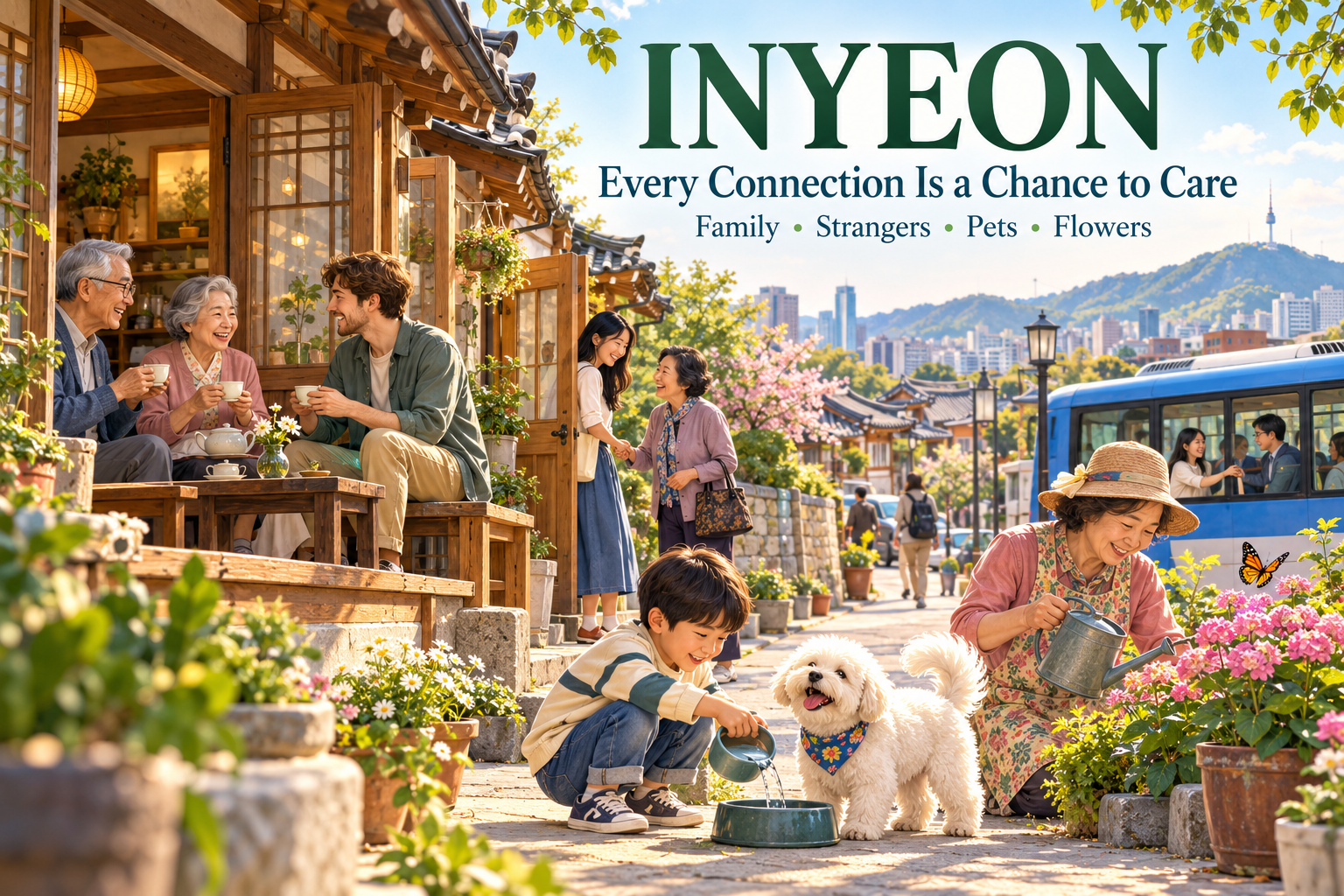
You board a bus and sit beside a stranger. They look out the window; you check your phone.
A few stops later, they get off. You never learn their name.
Yet a thought stays with you: could there be something meaningful about even this brief encounter?
Back home, your dog greets you with a wagging tail. On the balcony, a flower that was tightly closed
yesterday has opened. What brought these particular lives into yours?
In Korea, there is a word people often use when they wonder about such connections: inyeon .
In everyday conversation, it can mean a meaningful connection, the circumstances that bring people
together, or a bond that seems to reach beyond one lifetime. No single English word captures all its
shades of meaning. It is easy to think of inyeon when we meet a partner or remember our parents.
But what about siblings, friends, teachers, neighbors, or the stranger on the bus? What about our pets—
and even the plants we bring home?
Buddhist teachings offer a thoughtful way to explore these questions. They also help us distinguish a moving
story about destiny from what a scripture actually says.
1. Does Marriage Really Require “Five Hundred Eons”?
You may hear that a couple must share five hundred eons of connection before becoming husband and wife.
Similar sayings assign different numbers to brushing past someone, being born in the same country, or
becoming family.
These sayings can make an ordinary meeting feel extraordinary. However, the exact claim about marriage
requiring five hundred eons could not be verified in the scriptures consulted for this article.
The numbers also vary across popular retellings. They should not be presented as an established Buddhist
chart of relationships.
An eon, or kalpa, is an immense span of time in Buddhist thought. It is not simply another word for one lifetime.
We can appreciate the poetry of these expressions without treating them as a mathematical rule.
A friendship is not less valuable because someone has assigned marriage a larger number.
Affection does not need a cosmic scorecard.
2. Is Inyeon an Invisible Reservation System?
In daily life, inyeon often describes a special bond between people. In Buddhist teaching, causes and
conditions point toward a wider understanding: things arise in dependence on conditions.
The Paccaya Sutta—the discourse on conditions, SN 12.20—explains dependent arising in relation to the
development of suffering. Applying this perspective to everyday encounters can help us notice how many
circumstances make a meeting possible.
Consider that bus seat. You left home at a particular time. The other passenger chose that route.
The bus arrived, someone got off, and a seat became available.
Change just one circumstance, and you might never have sat together.
This is an everyday illustration of conditionality, not a claim that the scripture describes bus journeys.
Nor does it prove that the passenger was your spouse in a previous life.
“Many conditions brought us together” and “we had a specific relationship in a past life” are different statements. Accepting the first does not establish the second.
Our present choices matter too. Inyeon need not be imagined as an invisible booking system in which every
encounter was reserved long before we were born.
3. A Couple Asked About Their Next Life.
The Buddha Spoke About Their Shared Practice.
In AN 4.55, often translated as Living in Tune, a couple known as Nakula’s father and Nakula’s mother
approach the Buddha. They want to remain together in this life and meet again in the next.
It is a remarkably human wish. Anyone who has loved a partner deeply can recognize the feeling: could we
find each other again?
The Buddha’s response emphasizes harmony in four qualities: faith, ethical conduct, generosity, and wisdom.
The teaching directs their attention toward the life they cultivate together. It does not give them a number of
eons to calculate.
What might this look like in a marriage today? Listening without interrupting.
Being honest. Sharing responsibilities when life becomes difficult. Avoiding cruel words during an argument.
These are modern examples inspired by the teaching, rather than a literal list from the discourse.
Calling a marriage “a deep connection” does not repair the hurt caused by daily disrespect.
The tenderness of a relationship depends partly on how two people treat each other now.
4. Parents, Siblings, Friends, and Teachers: A Connection Comes with Responsibilities
The Sigalovada Sutta (DN 31) offers practical guidance on relationships. It describes reciprocal responsibilities
between parents and children, teachers and students, spouses, and friends, among others.
Children are encouraged to care for their parents, while parents have responsibilities toward their children.
Students should approach learning respectfully, while teachers should teach conscientiously.
Friendship is also examined carefully. The discourse values friends who help in difficulty, share happiness
and sorrow, and encourage what is good. A relationship’s label is not enough; conduct matters.
This gives us a useful way to remember an old teacher or a lifelong friend. We can ask what we learned from
one another, how we helped, and what we still owe in gratitude.
Siblings remind us that closeness does not guarantee understanding. Two people can grow up in the same
house and carry very different memories of it. Being family does not install an automatic translator between
our hearts. Sometimes the closest relationships require the most patient listening.
Other discourses extend the picture across rebirth. SN 15.14–19 says that, in the wandering of rebirth whose
beginning cannot be discerned, it is difficult to find a being who has not previously been one’s mother, father,
brother, sister, son, or daughter. These passages emphasize the long suffering of that wandering and
encourage release from it. They do not identify the previous-life role of a particular neighbor.
Read through the lens of compassion, they can encourage us to treat unfamiliar beings with greater care.
A stranger wants to live and avoid suffering, just as our loved ones do.
That does not mean enduring abuse because someone is family or calling exploitation a karmic duty.
Caring for a relationship can include setting boundaries that prevent further harm.
5. What About Everyone Living in the Same Country or Town?
We will never meet most of the people who share our country or hometown. Still, our lives depend on many of
them. We use shared roads and services. A farmer’s work reaches our dinner table. A bus driver helps us arrive
safely. Someone we never notice makes part of our ordinary day possible.
This is a present-day reflection on shared conditions, not a scriptural formula assigning eons to nationality or
residence.
The Karaniya Metta Sutta, commonly called the discourse on loving-kindness (Sn 1.8), encourages goodwill
toward beings near and far, seen and unseen. Its scope gives us no reason to stop compassion at a national
border.
We can value our local community while remembering that people elsewhere also seek safety, food, affection,
and peace.
And the stranger beside us? We do not have to start a conversation or turn every encounter into a friendship.
Sometimes kindness means moving a bag off a seat, lowering our voice, or making room for someone to pass.
A brief meeting can be treated well without becoming a dramatic story.
6. Could My Dog Have Been My Family in a Previous Life?
Anyone who has loved a pet may understand the question: how did this particular little creature become part
of my life?
Among countless animals, you came to share a home with this one. You learn its habits; it learns yours.
Your footsteps become a familiar sound. It is natural to describe that bond as inyeon.
But a specific claim that your dog was once your parent or child would require grounds beyond the affection
you feel today.
The Mahayana Brahma Net Sutra—the Fanwang Jing, distinct from the early Buddhist discourse with a similar
English title—encourages compassionate protection of beings. Its twentieth minor precept asks practitioners to
regard beings throughout the realms of rebirth as parents.
This widens the circle of care. It does not tell us which name to attach to an animal’s supposed previous life.
A dog cannot explain its pain in human words. Living with one therefore requires attention: clean water, suitable
food, exercise, medical care, and a lasting commitment to its welfare.
An inspiring story about a past-life bond should lead toward that care. When an animal is ill, taking it to the vet
matters more than finding a beautiful explanation for the meeting.
7. Can We Have Inyeon with a Flower?
The plant on your balcony also arrived through many conditions: a seed or cutting, soil, water, sunlight,
the people who grew and transported it, and your decision to bring it home.
Now your window, your watering habits, and the seasons affect its growth. Its flowers, in turn, may brighten
your morning. In this everyday sense, a relationship has developed.
However, Buddhist traditions generally distinguish plants from sentient beings: beings understood to have
conscious experience. The status of plants has been discussed in different ways across Buddhist traditions,
but we should not simply assume that a flowering tree is a human relative reborn.
That distinction does not make plants unworthy of care. They belong to the living environment that supports us.
We can respect them without making an unsupported claim about their previous lives.
Here, connection can mean that a plant has become part of our daily life and that our actions affect it.
Plants also give us wonderfully inconvenient lessons.
Telling a flower to bloom faster rarely works. More water is not always better. Caring well requires noticing
what is needed, rather than imposing what we want.
These are reflections inspired by the theme of conditions and care, not direct scriptural statements about
houseplants.
8. A Connection Can Change Through What We Do Today
The Sivaka Sutta (SN 36.21) rejects the view that every pleasant, painful, or neutral feeling is caused entirely
by past action. It discusses several sources of feelings, including bodily conditions and seasonal changes.
The discourse concerns feelings, not a catalogue of relationships. Still, it offers a useful caution when we apply
Buddhist ideas to daily life: do not explain every conflict or hardship as a debt from a previous birth.
People, animals, and plants enter our lives through many circumstances. We cannot verify that every meeting
fulfills a particular past-life promise. Keeping a clear distinction between scriptural teaching and imaginative
storytelling makes the discussion more trustworthy.
Yet there is much we can do without solving that mystery.
Thank a partner. Check on a parent. Listen again to a sibling. Help a friend. Make a little room on the bus.
Fill the dog’s water bowl. Check the soil before watering a plant.
We may not know how many lifetimes, if any, brought a particular encounter about. We can still notice whether
today’s words caused pain or offered comfort.
To cherish inyeon is to care for the connection in front of us. When wonder about the past becomes
kindness in the present, the teachings find a place in our homes, our neighborhoods, and even the quiet seat
beside a stranger.
'Korean Culture Explained' 카테고리의 다른 글
| When Does a Crush Become a Relationship? MBTI and the Space Between Us (0) | 2026.09.28 |
|---|---|
| Korea Doesn’t Lock Its Past Behind Museum Glass (1) | 2026.09.16 |
| How Does Korean Food Delivery Find You Anywhere? (0) | 2026.09.12 |
| Why Is K-pop More Than Just Music? (0) | 2026.09.08 |
| Why Are Dreams Considered Meaningful in Korea? (0) | 2026.09.01 |


