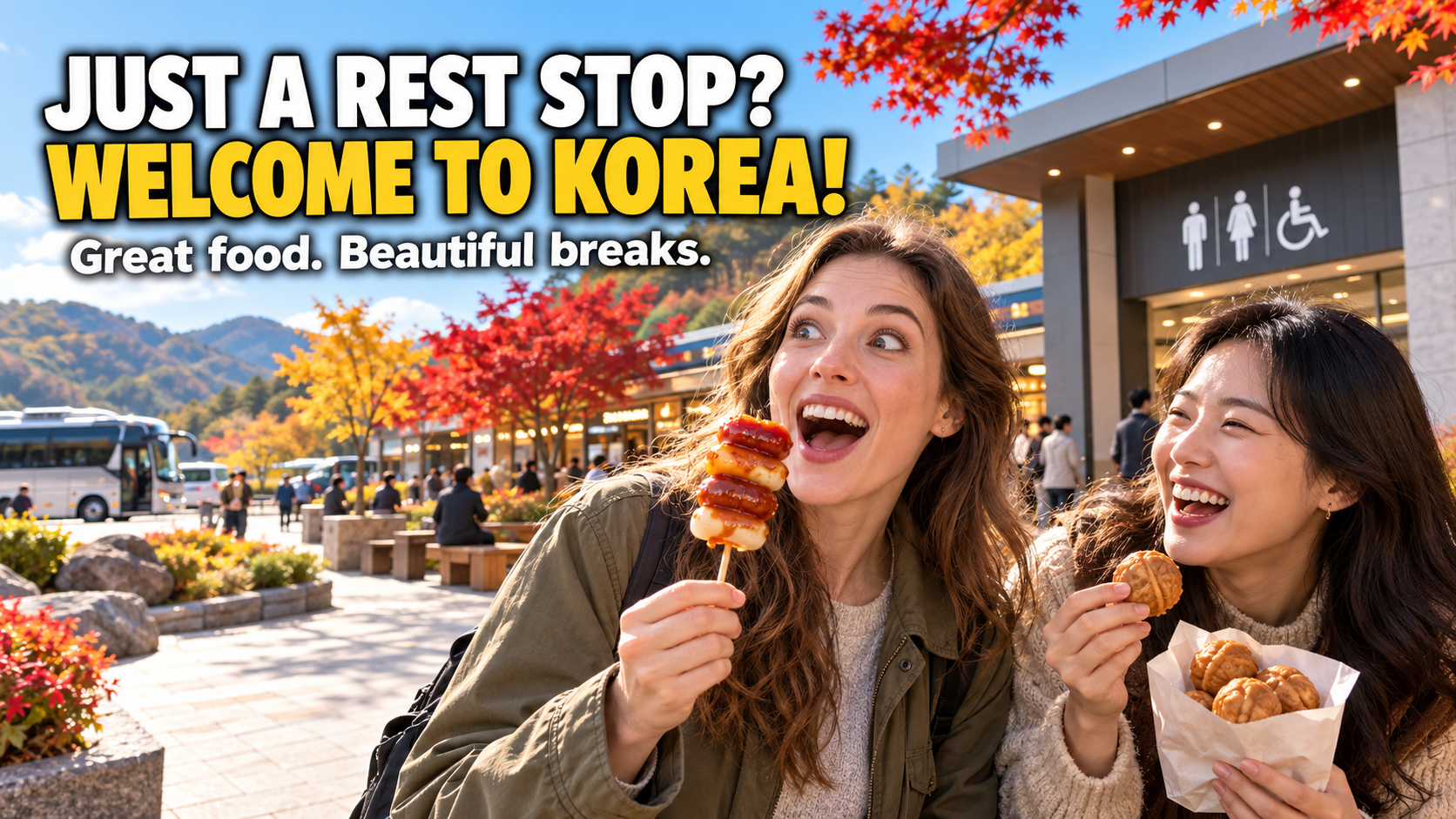
Food, comfort, and clever ideas at Korea's highway rest areas
1. “We're only stopping for a minute, right?”
Seoul's apartment towers have given way to mountains. Your legs need a stretch, and your Korean friend points
to a sign: hyugeso, a highway rest area. You expect a bathroom, a bottle of water, and a quick return to the car.
Then the door opens. Something sweet is baking. Someone walks past with a steaming bowl.
A child studies a skewer with intense concentration.
“Is this a rest stop or a small food festival?”
“Bathroom first,” your friend says. “Then we can investigate.”
This imaginary encounter introduces a real feature of Korean road travel. Major service areas combine food courts, snacks, regional goods, toilets, and fuel facilities.
How many are there? A Ministry of Land, Infrastructure and Transport announcement dated May 1, 2024 reported
236 expressway service areas nationwide. That is a dated official figure, not a verified total for October 2026.
Smaller drowsy-driving stops and facilities on ordinary highways should not simply be added to the same count.
2. The comfort behind a bathroom door
A bathroom can shape your impression of a journey before a famous monument does. When you urgently need one, clear directions and a well-maintained space are more than minor conveniences.
The important details need not be futuristic. A clean floor, somewhere to wash your hands, and room to manage a
bag all help.
“Travel guides should give this more space,” our fictional visitor says.
That relief should not become a claim that every Korean rest stop is spotless. Conditions vary, and holiday crowds
can bring queues. A government improvement plan announced on May 1, 2024 addressed aging facilities and toilet cleanliness. Comfort depends on maintenance and the people doing it, not simply attractive architecture.
3. Follow your nose
With the urgent task finished, the food becomes difficult to ignore. Hodugwaja are little walnut-shaped cakes,
typically with a sweet filling and walnut inside. Sotteok-sotteok puts sausage and rice cake together on a skewer.
Say the name, take a bite, and suddenly the break has acquired a soundtrack.
Different stops offer different menus. Do not expect every snack everywhere, particularly late at night.
If you have dietary restrictions, check ingredients: a filling may contain nuts, while a broth may contain meat or
seafood.
4. A garden beside the expressway
Some service areas offer another surprise: places worth walking around. Korea Tourism Organization describes Deokpyeong Eco-Service Area's garden, with flowers, trees, and art installations. Suddenly the season outside
the car window has a smell and a temperature.
Naerincheon offers a different architectural experience. Its building spans the expressway, and the builder
describes a design intended to preserve the surrounding natural environment.
Tourism coverage introduces its mountain setting and viewing spaces.
These are distinctive examples, not a promise that every stop has landscaped gardens or panoramic views.
Check access to individual spaces before planning around them. Still, they show how a place for taking a break
can become part of the sightseeing itself.
5. Different travelers need different breaks
One passenger needs coffee. Another needs somewhere to care for a baby. An electric-car driver needs charging. Someone traveling with limited mobility needs to know the route from parking to the building.
Korea Expressway Corporation's service-area information lists facilities such as nursing rooms, EV charging, pharmacies, and vehicle maintenance. Availability varies. A listed charger does not mean an available charger,
and a late-night arrival does not mean every restaurant will be open.
Check the exact stop and direction of travel. A familiar name on the opposite carriageway may not be the stop you
can enter.
6. A helpful line beneath the wheels
Back on the road, colored guidance lines catch the visitor's eye. Pink and green lines help make routes through complicated junctions easier to follow.[8] The idea is appealingly simple: bring another visual clue closer to the
driver's field of view.
They supplement signs and lane markings; they do not replace them. Choose lanes early and never make a
sudden maneuver just to follow a color.
7. A place to stop safely
Snacks and photographs do not replace rest. Korea also has smaller drowsy-driving rest areas, called joreum
swimteo, where tired drivers can pause. Do not expect the shopping or dining choices of a large service area.
Their essential attraction is somewhere to take a break.
The expressway shoulder is not a normal resting place. Use a designated stopping area that you can enter safely.
Bus passengers have their own small challenge. Some medium- and long-distance services make scheduled
rest-area stops.[9] Before exploring, check the departure time and note the bus number and parking position.
Once several similar coaches are lined up, confidence can disappear surprisingly quickly.
Enjoy the stop, but leave yourself time to return.
8. The journey you didn't plan
The car sets off again.
Our visitor is fictional, not a quoted traveler. Reactions differ. Yet a rest area offers a useful window into everyday
Korea: moving people still need meals, rest, and care for their families.
The destination usually goes on the map first. The memory may begin somewhere less expected.
Our visitor reaches for the last walnut cake. “Next time, perhaps we should leave a little more time for the stops.”
“Good idea,” the driver says. “And enough time for me to rest too.”
'Korean Culture Explained' 카테고리의 다른 글
| Are We Meant to Meet? The Korean Idea of Inyeon, from Family to Flowers (0) | 2026.10.02 |
|---|---|
| When Does a Crush Become a Relationship? MBTI and the Space Between Us (0) | 2026.09.28 |
| Korea Doesn’t Lock Its Past Behind Museum Glass (1) | 2026.09.16 |
| How Does Korean Food Delivery Find You Anywhere? (0) | 2026.09.12 |
| Why Is K-pop More Than Just Music? (0) | 2026.09.08 |


